Fragrance is one of the oldest human practices on earth. It predates writing. It outlasted empires. Today it’s a $60 billion global industry, and it’s growing. This is Part 1 of a four-part series covering everything worth knowing: from ancient Tamil roots to the Elixir craze, from the nose behind your bottle to what to pair it with in your glass.

Notes on Fragrance — Complete Series
1. Why Fragrance Matters
The Science of SmellOf all the senses, smell has one of the most direct routes to the limbic system, the part of the brain that governs memory and emotion. A single note can transport you to a specific afternoon twenty years ago with more precision than a photograph can.
This isn’t poetic exaggeration, though the science is more nuanced than it’s often given credit for. Olfactory signals travel from the olfactory bulb to the amygdala and hippocampus without first passing through the thalamus, the relay station most other sensory information is routed through first, which is one reason scent is so often linked to sudden, involuntary memory. It’s called the Proustian effect, named after the writer Marcel Proust, who described being transported entirely by the smell of a madeleine dipped in tea.
Fragrance is also deeply personal. The same bottle smells different on every person who wears it. Your skin chemistry, diet, stress levels, and even the time of day all affect how a scent develops. This is why sampling matters. And it’s why fragrance, at its best, is a form of expression that nobody else can replicate exactly, not simply a luxury purchase.
Key Terms Worth KnowingFragrance has its own vocabulary. A few terms come up constantly throughout this series. There is a full glossary in Part 4 as an appendix. Worth bookmarking as a reference as you go.
2. A Brief History of Perfumery
The word perfume comes from the Latin per fumum, meaning through smoke. The earliest perfumers were priests, not artisans or chemists. Burning aromatic resins like frankincense and myrrh was how ancient civilizations communicated with their gods. Scent was sacred before it was personal.
Frankincense and myrrh are among the oldest perfume materials in recorded history. They appear in Egyptian burial rites, in the Hebrew Bible, and of course in the story of the three wise men. These two resins were so valuable in the ancient world that they were considered gifts fit for kings. Frankincense remains a cornerstone of Middle Eastern and niche Western perfumery to this day.
Mesopotamia and Egypt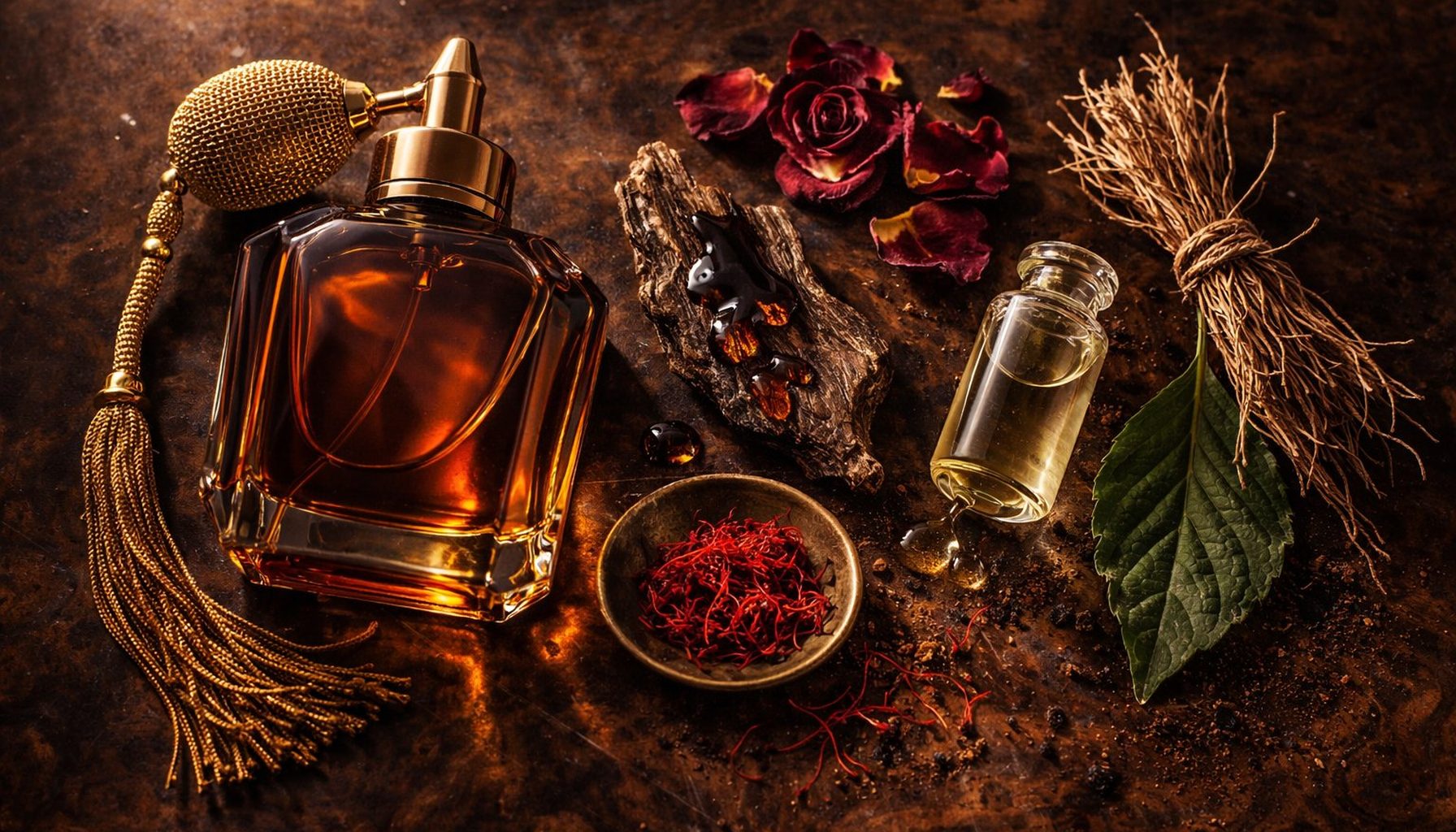
The first perfumer recorded by name was a woman. Tapputi-Belatekallim was an overseer at the royal palace of Assur, in Assyrian Mesopotamia, and a cuneiform tablet dated to around 1200 BCE records her methods: flowers, oil, calamus, myrrh, and balsam, distilled and filtered again and again. She is often called the earliest chemist known to us by name. The Egyptians used kyphi, a compound temple incense that Plutarch records as a blend of sixteen ingredients, though the surviving recipes — inscribed at Edfu and Philae, and copied by Dioscorides, Plutarch, and Galen — do not agree on the list. Cleopatra, famously, is said to have scented the sails of her ships so that her arrival was announced on the wind before she was seen. Plutarch, our earliest source for that barge, describes purple sails, silver oars, and clouds of incense burning on the riverbanks rather than perfumed canvas.
The Tamil ContributionTwo of modern perfumery’s most essential ingredients trace their names directly to Tamil. Tamil is one of the world’s oldest classical languages, still spoken today in Tamil Nadu, Sri Lanka, Singapore, Malaysia, and parts of Southeast Asia.
Vetiver takes its name from the Tamil veṭṭivēr. The plant originates in southern India, and Ayurvedic tradition has long described its aromatic and cooling properties. Tamil Nadu and Kerala remain major vetiver-producing regions to this day. The word itself only entered French in 1824, and English around 1858, centuries after Tamil speakers had already made it central to their medicinal and spiritual practices.
Patchouli comes from the Tamil words pachchai (green) and ilai (leaf). Its use in South India predates its arrival in the West by centuries. Before Europeans ever encountered it, patchouli was burned to purify air and used in spiritual practices across the subcontinent. When Indian-made shawls arrived in Britain in the 19th century, traders used patchouli to protect the fabric from moths. Europeans fell in love with the smell before they even knew what they were smelling.
Indian Influences: Rose, Sandalwood, and Oud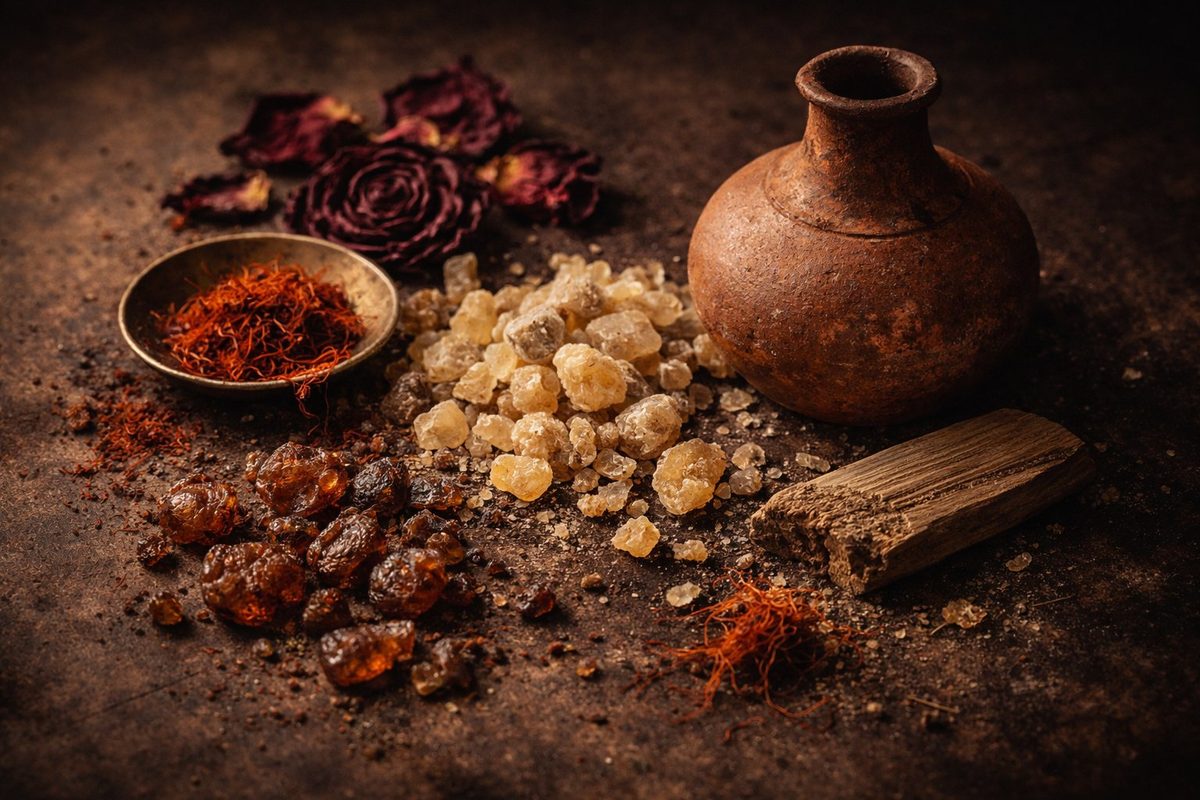
India’s contribution to perfumery goes far deeper than two ingredients. Perfume and perfumery existed in the Indus Valley civilization, which runs from roughly 3300 BCE to 1300 BCE. The Ayurvedic compendia Charaka Samhita and Sushruta Samhita catalogue aromatic plants, resins, and medicated oils in detail, though the deg-and-bhapka distillation that produces ittar — concentrated natural perfume oil — is a much later, Mughal-era development.
Sandalwood from Mysore, in southern India, remains one of the most prized raw materials in perfumery. Its warm, creamy, and long-lasting base note is irreplaceable. Indian rose, particularly from Kannauj in Uttar Pradesh, sometimes called the perfume capital of India, has been distilled into attar for centuries by the deg-and-bhapka method, certainly since the Mughal era.
Oud is also known as agarwood. The word oud comes from the Arabic al-oud, meaning the wood. It originated in the forests of South and Southeast Asia before traveling west along the spice routes. The agarwood tree, infected by a specific mold, produces a dark resin as a defense mechanism. That resin, when harvested and distilled, becomes oud oil, one of the most expensive raw materials on the planet, historically reserved for royalty across the Arab world and South Asia alike.
Persian InnovationIf South Asia gave perfumery its ingredients, Persia gave it its technology. The Persian polymath Abu Ali al-Husayn ibn Abdullah ibn Sina, known in the West as Avicenna, is commonly credited with refining the process of steam distillation around 1000 CE. Working with the Damask rose, he showed that passing steam through petals, then condensing the vapor, produced a pure, light essential oil. Credit him with refining rather than inventing, though: al-Kindi, in Baghdad more than a century earlier, had already written down the distillation of rose oil. What the method displaced were liquid perfumes made as crude blends of oil and crushed plant matter: heavy, inconsistent, and short-lived.
Steam distillation made fragrance portable and precise. It made rose water possible. And it laid the foundation for every bottle of perfume made since. Ibn Sina’s method has barely changed in a thousand years.
Persian culture also contributed saffron, musk, and ambergris, ingredients that remain central to oriental and Middle Eastern perfumery today. The word attar reaches English through the Persian ‘atir, perfumed, which comes in turn from the Arabic ‘itr, perfume.
The Arab Golden Age and European AwakeningDuring the Abbasid Caliphate in Baghdad (750–1258 CE), perfumery became a science. Al-Kindi, sometimes called the father of Arabic perfumery, wrote extensive treatises on extraction, distillation, and blending. Scholars catalogued hundreds of ingredients from across the trade routes that connected Asia, Africa, and Europe.
Fragrance reached Europe through two paths: the returning Crusaders in the east, and the Moorish trade routes through Al-Andalus in the west. By the Renaissance, Italian courts had become centers of perfumery. Catherine de’ Medici brought her Florentine perfumer René le Florentin with her when she married the French king, and France has been the capital of the fragrance world ever since.
The Oldest Fragrance Institutions Still OperatingThree institutions deserve mention for anyone who wants to understand where the industry came from.
Officina Profumo-Farmaceutica di Santa Maria Novella in Florence has been operating since 1221, when Dominican friars ran an apothecary at the church. They opened to the public in 1612. Their oldest fragrance still in production is Acqua di Colonia, also known as Acqua della Regina, traditionally attributed to 1533 and to the apothecary Renato Bianco — the René le Florentin above — and tied to Catherine de’ Medici’s marriage. That date is traditional rather than documented. The shop in Florence has barely changed in four centuries.
Farina 1709 in Cologne is considered the world’s oldest perfume factory. Johann Maria Farina, an Italian immigrant, founded it in Cologne, Germany, in 1709. He created Eau de Cologne and named it after his adopted city. The German name for Cologne is Köln, and it is from this city that an entire fragrance concentration takes its name. The company remains in family hands, now in its eighth generation.
Grasse, in the south of France, was a leather-tanning town from the 12th century and became the flower-growing engine that fed European perfumery from the 16th century onwards, once its tanners began scenting gloves for the Italian fashion that arrived with Catherine de’ Medici’s entourage. It remains the spiritual capital of the fragrance world.
3. The Perfumer: The Nose
The TrainingThe person who creates a fragrance is called a perfumer. In the industry, the best of them are known simply as noses. It takes years of formal training to become one. ISIPCA in Versailles, the best-known school, runs seven initial programmes ranging from secondary level up to the equivalent of six years of higher education, and graduates then spend years working under experienced perfumers before being trusted to lead a creation.
Rarer Than AstronautsHere is a line the industry likes to repeat: there are more people who have flown in space than there are working perfumers. Treat it as a figure of speech rather than a headcount. Nobody publishes a census of perfumers, and the numbers you see quoted, usually a few hundred to a thousand worldwide, trace back to trade-press estimates rather than to any register. What is not in dispute is that the number is small, and that the title master perfumer, the highest rung of the craft, belongs to a much smaller group still.
A trained nose can identify and distinguish hundreds of individual aromatic materials. The palette they work from runs to a few thousand ingredients, depending on the house. A single fragrance may use anywhere from twenty to over a hundred of these materials, though a brand will typically only list three notes on a marketing card for simplicity.
Creating a fragrance is not fast. A simple brief can take six months. A complex niche composition can take three years. Ernest Beaux presented Coco Chanel with a set of numbered samples, 1 through 5 and 20 through 24, and she picked the fifth. The number stuck because, as she is quoted as saying, she showed her collections on the fifth of May.
The MastersSome of the most celebrated noses working today include Olivier Polge, Chanel’s in-house perfumer since 2015, who followed in his father Jacques’ footsteps; Francis Kurkdjian, co-founder of his own house and, since October 2021, perfume creation director at Parfums Christian Dior; Alberto Morillas of dsm-firmenich, co-creator of CK One with Harry Frémont and of a great deal else; and Dominique Ropion, given the title of master perfumer by IFF in 2018 and widely regarded as one of the greatest living perfumers.

From left to right: Dominique Ropion (IFF), Alberto Morillas (Givaudan), Jacques Cavallier-Belletrud (Louis Vuitton), Christine Nagel (Hermès), Francis Kurkdjian (Dior), Quentin Bisch (Givaudan).
The New GenerationAmong the newer generation, Quentin Bisch stands out. He tells interviewers he came to perfumery sideways, out of music and theatre, by way of a short internship in Grasse he never left. He works for Givaudan, and his credits are widely reported to include Delina for Parfums de Marly, Good Girl for Carolina Herrera, Le Beau Paradise Garden for Jean Paul Gaultier, and fragrances for Amouage’s Exceptional Extraits series. Givaudan does not publish perfumer biographies and the brands rarely name their noses on the bottle, so take all of that as the trade press has it rather than as company record. His approach, as he describes it, is to compose a fragrance the way a director stages a performance: strong ideas, careful construction, surprising effects.
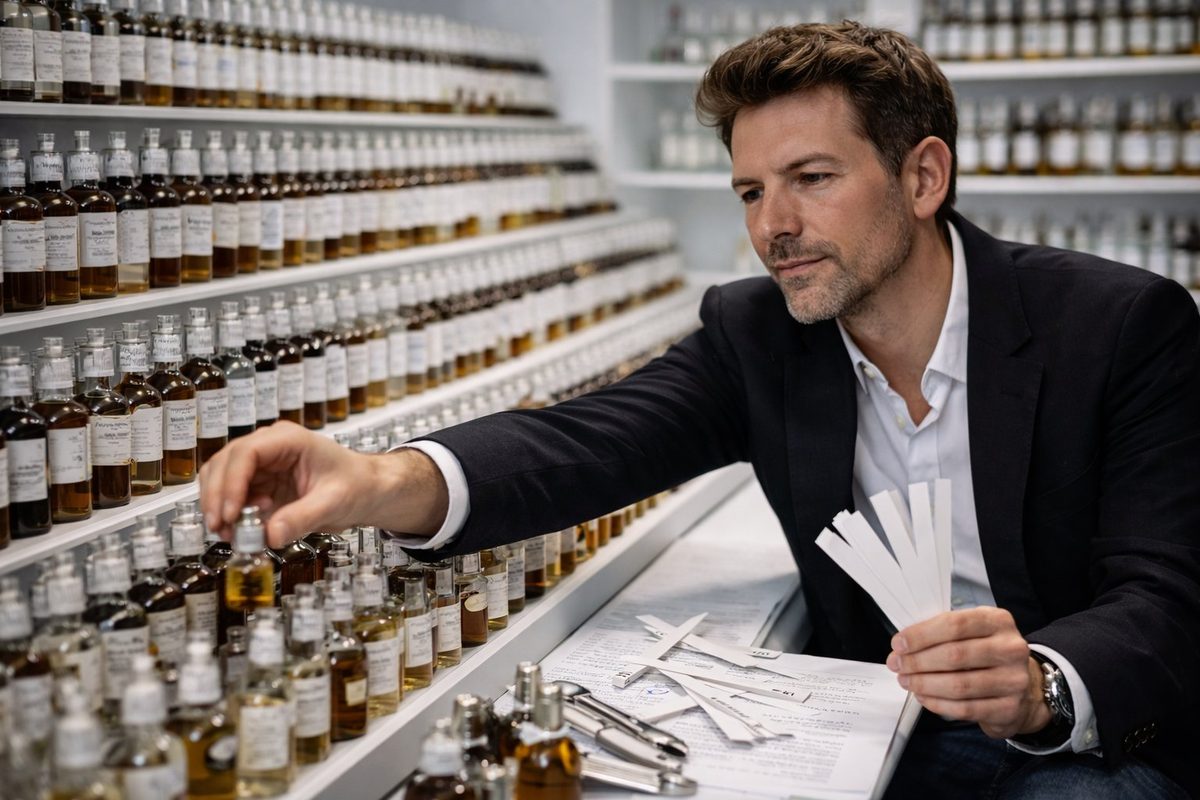
A perfumer’s palette runs to a few thousand individual ingredients. Creating a fragrance can take years.
4. Natural vs Synthetic Ingredients
The Case for NaturalsThere is a persistent idea that natural fragrance ingredients are inherently better than synthetic ones. It’s worth unpacking, because the reality is more interesting.
Natural ingredients are irreplaceable in many ways. The depth, complexity, and living quality of a genuine Bulgarian rose absolute or real oud oil from Assam is something no synthetic has fully replicated. Naturals carry the variation of their terroir. The same ingredient grown in different regions smells subtly different, just like wine grapes do.
The Case for SyntheticsBut synthetics are not the enemy. Many are essential. Ambroxan is one of the molecules that gives real ambergris its smell, formed when ambrein oxidises, but the perfumery material is not scraped off a beach: it is made from sclareol out of clary sage. It is responsible for the skin-close warmth and sillage of dozens of modern fragrances. Iso E Super gives cedar a creamy, shimmering quality that natural cedarwood oil cannot match. It is a woody, slightly smoky aroma chemical, technically an acetyl octahydronaphthalene rather than anything cedar-derived, and in practice a mixture of isomers; IFF patented it in 1975, and it is one of the reasons certain fragrances feel magnetic on skin. Musks, in their natural form, come from endangered animals. Synthetic musks allow those animals to exist undisturbed.
Synthetics also solve a practical problem. Some natural ingredients, oakmoss for example, a foundational note in classic chypre fragrances, are now heavily restricted by IFRA (the International Fragrance Association) on dermal sensitisation grounds, and the EU has gone further, banning outright the two sensitisers oakmoss carries, atranol and chloroatranol. Without synthetic alternatives, entire fragrance families would disappear.
Captive MoleculesSome houses go further. They develop and patent captive molecules: ingredients available exclusively to their perfumers that competitors cannot use. Firmenich’s Ambrox and Clearwood, Givaudan’s Akigalawood. These exclusive ingredients become part of a house’s signature and create a competitive moat that no clone can fully cross.
The best fragrances blend both naturals and synthetics. Knowing this makes you a more informed wearer and more skeptical of marketing that treats “all-natural” as a synonym for superior.