Notes on Fragrance · A Four-Part Series

Part 3: Fragrance and the World

Everything You Need to Know About Fragrance

March 20, 2026

Written by Gautam Kannan

Read This Bite-Sized → View complete article ↗

Part 3 zooms out: how fragrance interacts with the body and memory, the scale of the global industry, and why sustainability is no longer optional for houses that want to source the ingredients they depend on.

Notes on Fragrance — Complete Series

8. Fragrance and the Human Body

Skin Chemistry

Why does the same perfume smell different on different people? The answer is skin chemistry.

Your skin’s pH, natural oils, body temperature, and microbiome all interact with fragrance molecules and alter how they develop. A citrus top note that disappears in minutes on one person can linger for an hour on another. An oud base that smells powerfully smoky on one skin smells warm and woody on another. This is why a friend’s recommendation, however well-intentioned, is only a starting point.

Diet is often said to play a role too, though the specific claim that high-fat diets make a fragrance project harder is one I have not been able to trace to any controlled study. What is easier to observe is that hydrated skin holds fragrance longer than dry skin. Applying unscented moisturizer before spraying creates a base that extends wear noticeably.

Scent and Memory

Then there is the scent-memory connection. The olfactory system connects directly to the hippocampus and amygdala, the brain’s memory and emotion centers. No other sense routes this way. This is why a smell can trigger a fully formed emotional memory in an instant, without conscious thought.

DS & Durga’s Radio Bombay does this to me every time. One spray and I am back in my grandmother’s home in Chennai, the smell of her sandalwood chest in the corner of the bedroom. I have not been in that room in decades. The fragrance puts me there in seconds. When I smell Ralph Lauren Polo Green, I think of my father. Chanel No. 5 will always remind me of my mother. These associations formed on their own, quietly, over years. I never chose them.

Some perfumers design with this intentionally, structuring a composition around the associations they hope it will lay down. Frédéric Malle’s house exists to give perfumers the room to work that way: Dominique Ropion took Carnal Flower through 690 iterations before it was signed off. That is the ambition at the highest level of the craft.
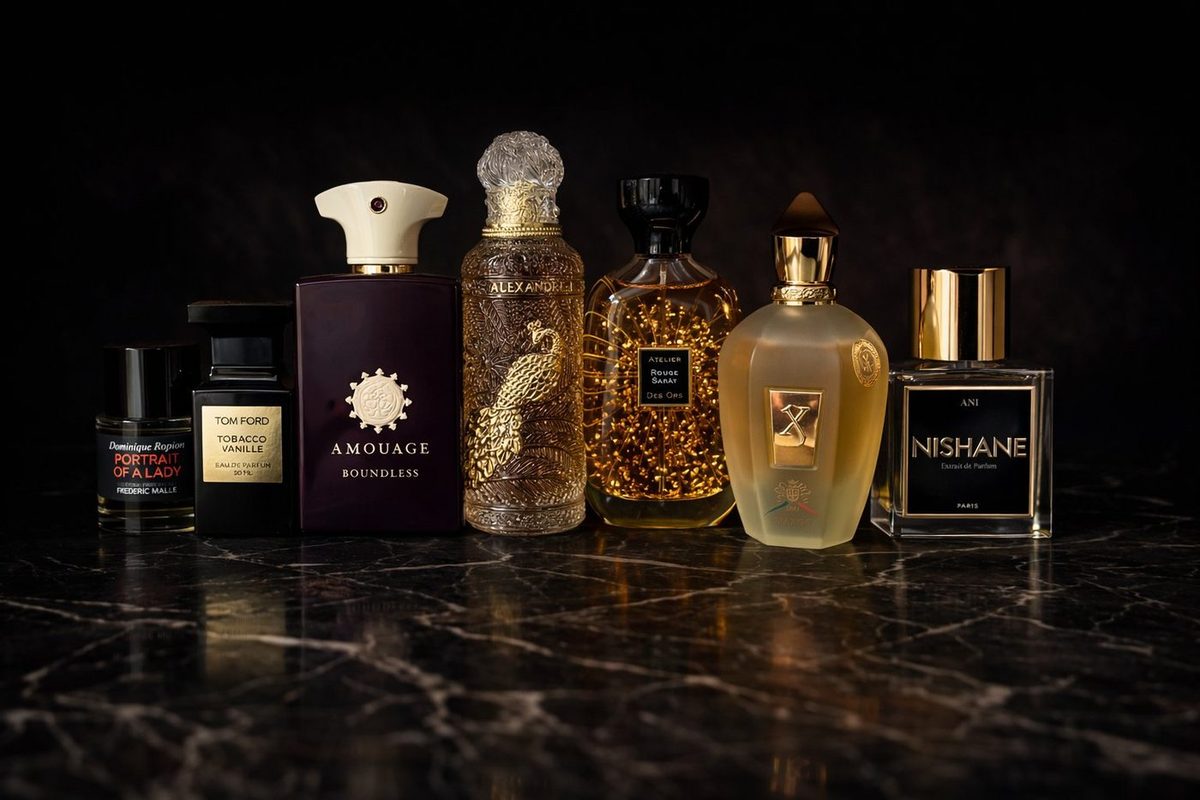
Seven niche fragrance bottles on a dark marble surface including Frederic Malle, Tom Ford, Amouage, Alexandre J, Atelier des Ors, Xerjoff and Nishane

From left to right: Frédéric Malle Portrait of a Lady, Tom Ford Tobacco Vanille, Amouage Boundless, Alexandre J Imperial Peacock, Atelier Des Ors Rouge Saray, Xerjoff Naxos, Nishane Ani.

↑ Back to top

9. Fragrance and the Global Economy

The Numbers

The fragrance industry is large, growing, and structurally important to multiple sectors.

The global perfume market is valued at around $60 billion in 2025 and is projected to approach $100 billion by the mid-2030s. This figure covers personal fragrances only. It excludes scented household products, room fragrances, and personal care products with added scent, which would more than double the number.

Key Players

The dominant players are familiar: LVMH (which owns Dior, Givenchy, and Maison Francis Kurkdjian, among others), Chanel, Coty, Estée Lauder, L’Oréal, and Puig. Behind them, a tier of independent ingredient suppliers, Givaudan, dsm-firmenich (formerly Firmenich and DSM), IFF, and Symrise, essentially supply the raw materials and aroma chemicals that the entire industry depends on.

The fastest growth is happening in Asia-Pacific, particularly India and China, as disposable incomes rise and personal grooming becomes a higher priority. The Middle East is widely described as the highest per-capita fragrance spending region in the world, though I have not found public data that establishes it. On total market value the lead sits with Europe rather than North America.

Fragrance is also one of the most recession-resilient luxury categories. An $80 bottle of perfume is still an accessible indulgence for people who cannot afford a $5,000 handbag.

Must-Know Fragrances

Two fragrances worth knowing in terms of commercial scale: Creed Aventus and Dior Sauvage are routinely cited as among the best-selling niche and designer fragrances in the world respectively. Dior Sauvage has been reported to be one of the top-selling men’s fragrances globally for several years running, though rankings of this kind rest on proprietary retail panel data that is never published in full. Creed Aventus commands a price point and following that most niche houses can only aspire to. Both are worth smelling regardless of whether you own them. They became what they are for a reason.

Frederic Malle is worth a separate mention here. His house, founded on the concept of giving named perfumers creative freedom, produces some of the most serious fragrances made today. Portrait of a Lady and Monsieur are two of the best things in my collection. The people behind the Frederic Malle counter are among the most knowledgeable in the business and worth getting to know.

↑ Back to top

10. Sustainability & the Future

The fragrance industry has a genuine sustainability problem, and the better houses are beginning to address it seriously.

Endangered Ingredients

Some of fragrance’s most important naturals are under pressure. Indian sandalwood is assessed as Vulnerable in the wild and its harvest in India is controlled by the state rather than by whoever owns the land; a wild tree needs something like thirty years before the heartwood is worth cutting. Agarwood, the source of oud, is scarce enough in the wild that every species of Aquilaria and Gyrinops has sat on CITES Appendix II since January 2005, with Aquilaria malaccensis listed a decade before that. Ambergris, the waxy substance from sperm whales that produces one of perfumery’s most prized fixatives, is now largely replaced by synthetic ambroxan — for legal reasons as much as ethical ones, since the sperm whale is on CITES Appendix I and has been listed as endangered under United States law since 1970. The industry’s reliance on slow-growing, rare, or animal-derived materials is a structural vulnerability.

Responsible Sourcing

Some houses are beginning to address this with real commitment. Chanel is long reported to work directly with flower growers in Grasse, the region whose perfume-plant cultivation UNESCO inscribed as intangible cultural heritage in 2018, though the house itself publishes almost nothing about how the arrangement works. Givaudan and dsm-firmenich both publish sustainability reports detailing ingredient sourcing practices.

The most ambitious example in the industry right now is Amouage’s Wadi Dawkah project. Since 2022, Amouage has been the custodian of Wadi Dawkah, a UNESCO World Heritage Site in the Dhofar region of Oman, home to a wild stand of Boswellia sacra whose size is usually given as around 5,000 trees, a figure that recurs across press coverage but that I could not match to any published count. In partnership with Oman’s Ministry of Heritage and Tourism, they have turned the site into what the house itself calls the first smart forest in the GCC, using geotagging and blockchain to trace every harvest from tree to bottle. That description is Amouage’s own and I have not been able to verify it independently. A visitor centre and distillery, designed by Milan-based Giò Forma Studio, is under construction and expected to open in 2027.

Perfumers are invited to sponsor individual trees at the site. I have sponsored one myself.
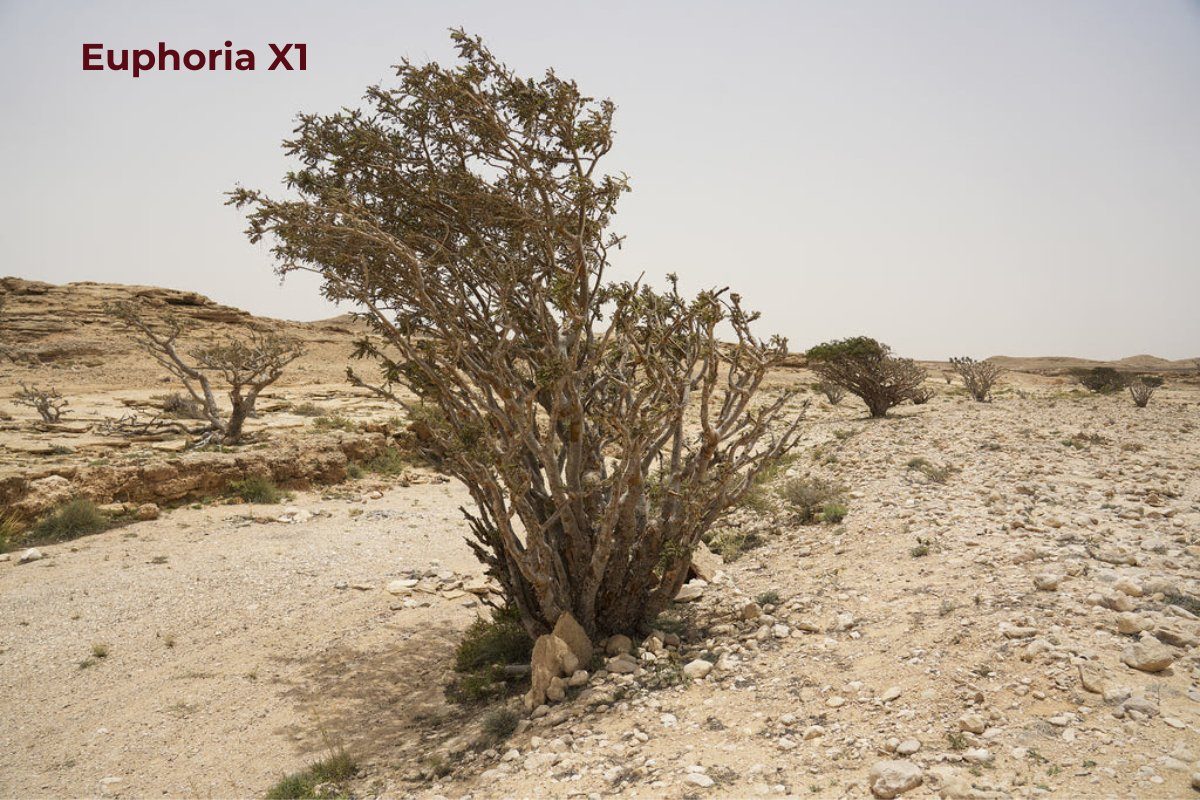
A Boswellia sacra frankincense tree at Wadi Dawkah, Oman, labelled Euphoria X1

Euphoria X1 — my sponsored frankincense tree at Wadi Dawkah, Oman. One of the Boswellia sacra trees at the UNESCO World Heritage Site, custodied by Amouage since 2022.

Similar programs exist elsewhere. Louis Vuitton runs its perfume operation out of Les Fontaines Parfumées in Grasse, though I could not find a published account of what its sourcing there actually commits to. Givaudan buys through a programme it calls Sourcing4Good, with a 2030 target for responsibly sourced materials and services. These are still the exception, not the rule, but the pressure is growing.

The Packaging Problem

This is where the industry has the most obvious room to improve, and the least excuse not to. A typical luxury fragrance bottle arrives inside a box, wrapped in tissue, cushioned with filler, sealed with a ribbon. The bottle itself is often glass that weighs more than the liquid it contains. Almost none of it needs to be this way.

Some houses are starting to offer refill programs, selling a refill bottle or pouch instead of a whole new presentation each time. This is a meaningful step. But refills remain the exception rather than the rule.

There is a compelling model in adjacent industries worth adopting more widely. Card companies like Botanical PaperWorks embed wildflower seeds in their paper packaging. The packaging itself becomes something you plant rather than discard. Fragrance houses could easily use seed-embedded paper for outer boxes. Some smaller niche brands already do. The barrier is a willingness to prioritize it, not technology or cost.

Other practical approaches worth wider adoption: biodegradable filler materials, minimal single-material packaging that is easier to recycle, concentrates that reduce liquid volume and therefore shipping weight, and glass standardization that makes bottle reuse more practical.

The consumer side of this equation matters too. Buying fewer bottles of better quality, using what you own before adding more, choosing houses with transparent sourcing and refill programs. A collection of 850 bottles, I will freely admit, is not the most sustainable position. But it starts with knowing the problem exists.


← Part 2: Understanding Fragrance View Complete Article Part 4: The Experience →
Subscribe

Sources

  1. Olfactory signals reaching the amygdala and hippocampus directly, and olfaction being the one sense not relayed through the thalamus before it reaches cortex: Rachel S. Herz, “The Role of Odor-Evoked Memory in Psychological and Physiological Health,” Brain Sciences, 2016, MDPI, which states that “unlike other sensory systems where neural processing is directly integrated in the thalamus prior to processing in the cortex, olfactory information is indirectly processed through the medio-dorsal nucleus of the thalamus,” and that primary olfactory cortex includes both the amygdala and the hippocampus. Venkatesh Murthy of Harvard on odors taking “a direct route to the limbic system”: Harvard Gazette.
  2. Skin pH, sebum, temperature and microbiome altering how a fragrance develops is repeated everywhere in the trade press, but I could not reach a controlled study for it, and none at all for the claim that a high-fat diet increases projection. The body text has been hedged accordingly. Nothing in this paragraph is cited because nothing in it could be.
  3. The global perfume market at $60.0 billion in 2025, $63.5 billion in 2026, and a forecast $96.1 billion by 2033 at a 6.1% CAGR, with Asia Pacific the fastest-growing region at 6.8%: Grand View Research. The same source puts the largest revenue share with Europe at 35.4% in 2025, not with North America; the article previously said North America and has been corrected. The figure covers personal fragrance only.
  4. India as one of the engines of Asia-Pacific growth: the Indian perfume market at USD 2,354.3 million in 2024, forecast to USD 4,079.1 million by 2030 at a 9.6% CAGR, driven by rising disposable income, organised retail and e-commerce: Grand View Research, India outlook. No comparable public figure was reachable for the claim that the Middle East has the highest per-capita fragrance spend in the world; that sentence is now hedged in the body.
  5. LVMH owning Parfums Christian Dior, Givenchy Parfums (in the group since 1957) and Maison Francis Kurkdjian (since 2009), alongside Guerlain, Acqua di Parma, Loewe Perfumes, Kenzo Parfums and Officine Universelle Buly: LVMH’s own list of its Perfumes & Cosmetics Maisons.
  6. Givaudan and dsm-firmenich both publishing sustainability reporting on ingredient sourcing: Givaudan’s Sourcing4Good programme and 2025 Integrated Report, Givaudan; dsm-firmenich’s Integrated Annual Report 2025, ESG Factbook and its commitment to complete its Naturals Sourcing Program by 2030, dsm-firmenich. dsm-firmenich’s Perfumery & Beauty business unit and roughly €9bn of continuing sales: dsm-firmenich. The company’s own site does not state the date the DSM and Firmenich merger completed, so no date is given in the article.
  7. Editions de Parfums Frédéric Malle launched in 2000 and built on being “the first to bring perfumers from the shadows to the spotlight, treating them as authors and revealing their names on the bottles,” with perfumers granted “unique freedom”: the house’s own account. Dominique Ropion is listed among its perfumers on the same site. The 690 iterations of Carnal Flower, and the 2015 sale of the house to Estée Lauder, come from Wikipedia’s entry on Frédéric Malle, used here as a cross-check because no brand page carries them. The article’s earlier claim that Ropion has spoken publicly about building “emotional anchors” into compositions could not be sourced and has been removed.
  8. Indian sandalwood (Santalum album) assessed by the IUCN as Vulnerable in its wild native range, wild trees taking roughly thirty years to reach harvestable heartwood against fifteen to twenty on plantation, repeated Indian export shutdowns, and the scale of the Australian plantation answer: Tisserand Institute. Indian law reserving the cutting of sandalwood to the state, with private cultivation only permitted from 2002, and a national export ban on the timber: Wikipedia’s Santalum album entry, cited as a cross-check because the IUCN assessment page would not load. No Santalum species is claimed here to be CITES-listed, and none is.
  9. Aquilaria malaccensis in CITES Appendix II from 16 February 1995 (CoP9), and the whole of Aquilaria and Gyrinops added at CoP13 in 2004 with effect from 12 January 2005: CITES’s own CoP19 Doc. 62.2, with the listing dates also tabulated in a Plants Committee agarwood overview. Indonesia’s listing proposal, which records lowland forest loss in Sumatra and Borneo and collectors finding agarwood harder to locate but explicitly states “the field data on the population trend is not available”: CoP13 Prop. 49. Because neither CITES document supports a maturation figure, the article no longer says agarwood trees “take decades to mature.”
  10. The sperm whale on CITES Appendix I throughout its range, protected and listed as depleted under the Marine Mammal Protection Act, and listed as endangered throughout its range on 2 June 1970 under the Endangered Species Conservation Act of 1969: NOAA Fisheries. The MMPA defines a “marine mammal product” as “any item of merchandise which consists, or is composed in whole or in part, of any marine mammal,” 16 U.S.C. §1362(7), and makes it unlawful “to transport, purchase, sell, export, or offer to purchase, sell, or export any marine mammal or marine mammal product,” 16 U.S.C. §1372(a)(4). That US possession and trade in ambergris is prohibited under the Endangered Species Act, and that Australia bans commercial import and export of it under the EPBC Act 1999, is from Wikipedia’s ambergris entry, used as a cross-check; the underlying statutes are the ones linked above, and no US agency page setting out the ambergris position specifically was reachable in this session.
  11. Ambergris “mostly replaced by synthetic ambroxide” in perfumery: Ambergris. Ambroxide (sold as Ambroxan) being one of the key constituents responsible for the odour of ambergris, working as both odorant and fixative, and now made industrially from sclareol out of clary sage oil: Ambroxide, citing Ullmann’s Encyclopedia of Industrial Chemistry. Both are Wikipedia and are named as such.
  12. Grasse: the skills related to perfume in the Pays de Grasse, including the cultivation of perfume plants, inscribed on UNESCO’s Representative List of the Intangible Cultural Heritage of Humanity in 2018: UNESCO. Chanel’s direct relationship with growers there is widely reported but is documented on no page I could reach, including Chanel’s own; the sentence has been hedged. The same applies to what Louis Vuitton commits to at Les Fontaines Parfumées.
  13. Boswellia sacra assessed as Near Threatened, most other Boswellia species Vulnerable to Critically Endangered, overharvesting, habitat loss and inequitable supply chains named as the main threats, and no Boswellia species currently listed on any CITES appendix: Forrest, Rutherford, Stott, Olander and Neale (2025), Centre for Middle Eastern Plants, Royal Botanic Garden Edinburgh, information document prepared for CITES CoP20.
  14. CITES CoP20 (Samarkand, closing 5 December 2025) adopting a set of decisions on Boswellia rather than an Appendix listing: Earth Negotiations Bulletin, 4 December 2025, which records the CoP adopting CoP20 Com.I.3. That the only botanical newly added to Appendix II at that meeting was Commiphora wightii, effective ninety days after 5 December 2025: American Herbal Products Association. The two accounts are consistent: the frankincense outcome was a work programme, not a listing.
  15. The Land of Frankincense inscribed as a UNESCO World Heritage property in 2000, with Wadi Dawkah as one of its four components and the place where “the frankincense tree (boswellia sacra) can still be found and frankincense is harvested to this day”; the property covers 849.88 hectares with a 1,243.24 hectare buffer zone: UNESCO World Heritage Centre. UNESCO publishes no tree count for the site.
  16. Amouage taking on the protection, restoration and expansion of Wadi Dawkah under an agreement with Oman’s Ministry of Heritage and Tourism, announced 6 September 2022, covering a five-kilometre site of Boswellia sacra in Dhofar and a planned visitor centre integrating harvesting, distillation, blending, ageing and manufacturing: Amouage’s announcement. That release gives no tree count, no opening year, no architect, and no mention of a smart forest, geotagging or blockchain. Amouage’s own site was unreachable in this session, so those claims are attributed to the house in the body rather than cited.
  17. The Ayn Dawkah visitor centre and production building at Wadi Dawkah, designed for Amouage by Giò Forma Studio of Milan with F&M Middle East Engineering Consultancy, a rammed-earth and dry-stone circular structure around a central frankincense garden, with completion given as Spring 2027: Giò Forma’s project page.
  18. Plantable seed paper embedded with wildflower, herb or vegetable seeds, made in card, packaging, box, wrap and sleeve formats and described by the maker as biodegradable and leaving “absolutely NO waste behind”: Botanical PaperWorks, a B Corp certified North American manufacturer.
  19. Dior Sauvage and Creed Aventus as perennial best-sellers: no audited public sales table exists for either. Global fragrance rankings are built from proprietary retail panel data, and neither LVMH’s nor Puig’s published reporting breaks out unit sales by fragrance. The sentence is hedged in the body for that reason, and nothing is cited for it here.
  20. Fragrance note pyramids and the composition of my own collection are from my own collection database.
← Previous Post Back to Journal Next Post →
Subscribe