This is the complete single-page version of the Notes on Fragrance series. Use your browser’s print function (Ctrl+P / Cmd+P) to save or print.
Fragrance is one of the oldest human practices on earth. It predates writing. It outlasted empires. Today it’s a $60 billion global industry, and it’s growing. On National Fragrance Day, here is everything worth knowing: from ancient Tamil roots to the Elixir craze, from the nose behind your bottle to what to pair it with in your glass.

Contents
- 1. Why Fragrance Matters
- 2. A Brief History of Perfumery
- 3. The Perfumer: The Nose
- 4. Natural vs Synthetic Ingredients
- 5. Fragrance Families
- 6. Understanding Concentrations
- 7. The Rise of the Clones
- 8. Fragrance and the Human Body
- 9. Fragrance and the Global Economy
- 10. Sustainability & the Future
- 11. Pairing Fragrance with Spirits
- 12. Where Fragrance Goes From Here
- Appendix: Fragrance Glossary
1. Why Fragrance Matters
The Science of SmellOf all the senses, smell has one of the most direct routes to the limbic system, the part of the brain that governs memory and emotion. A single note can transport you to a specific afternoon twenty years ago with more precision than a photograph can.
This isn’t poetic exaggeration, though the science is more nuanced than it’s often given credit for. Olfactory signals travel from the olfactory bulb to the amygdala and hippocampus without first passing through the thalamus, the relay station most other sensory information is routed through first, which is one reason scent is so often linked to sudden, involuntary memory. It’s called the Proustian effect, named after the writer Marcel Proust, who described being transported entirely by the smell of a madeleine dipped in tea.
Fragrance is also deeply personal. The same bottle smells different on every person who wears it. Your skin chemistry, diet, stress levels, and even the time of day all affect how a scent develops. This is why sampling matters. And it’s why fragrance, at its best, is a form of expression that nobody else can replicate exactly, not simply a luxury purchase.
Key Terms Worth KnowingFragrance has its own vocabulary. A few terms come up constantly throughout this post. Rather than define them inline each time, there is a full glossary at the end as an appendix. Worth reading before you start, or keeping open as a reference as you go.
2. A Brief History of Perfumery
The word perfume comes from the Latin per fumum, meaning through smoke. The earliest perfumers were priests, not artisans or chemists. Burning aromatic resins like frankincense and myrrh was how ancient civilizations communicated with their gods. Scent was sacred before it was personal.
Frankincense and myrrh are among the oldest perfume materials in recorded history. They appear in Egyptian burial rites, in the Hebrew Bible, and of course in the story of the three wise men. These two resins were so valuable in the ancient world that they were considered gifts fit for kings. Frankincense remains a cornerstone of Middle Eastern and niche Western perfumery to this day.
Mesopotamia and Egypt
The first perfumer recorded by name was a woman. Tapputi-Belatekallim was an overseer at the royal palace of Assur, in Assyrian Mesopotamia, and a cuneiform tablet dated to around 1200 BCE records her methods: flowers, oil, calamus, myrrh, and balsam, distilled and filtered again and again. She is often called the earliest chemist known to us by name. The Egyptians used kyphi, a compound temple incense that Plutarch records as a blend of sixteen ingredients, though the surviving recipes — inscribed at Edfu and Philae, and copied by Dioscorides, Plutarch, and Galen — do not agree on the list. Cleopatra, famously, is said to have scented the sails of her ships so that her arrival was announced on the wind before she was seen. Plutarch, our earliest source for that barge, describes purple sails, silver oars, and clouds of incense burning on the riverbanks rather than perfumed canvas.
The Tamil ContributionTwo of modern perfumery’s most essential ingredients trace their names directly to Tamil. Tamil is one of the world’s oldest classical languages, still spoken today in Tamil Nadu, Sri Lanka, Singapore, Malaysia, and parts of Southeast Asia.
Vetiver takes its name from the Tamil veṭṭivēr. The plant originates in southern India, and Ayurvedic tradition has long described its aromatic and cooling properties. Tamil Nadu and Kerala remain major vetiver-producing regions to this day. The word itself only entered French in 1824, and English around 1858, centuries after Tamil speakers had already made it central to their medicinal and spiritual practices.
Patchouli comes from the Tamil words pachchai (green) and ilai (leaf). Its use in South India predates its arrival in the West by centuries. Before Europeans ever encountered it, patchouli was burned to purify air and used in spiritual practices across the subcontinent. When Indian-made shawls arrived in Britain in the 19th century, traders used patchouli to protect the fabric from moths. Europeans fell in love with the smell before they even knew what they were smelling.
Indian Influences: Rose, Sandalwood, and Oud
India’s contribution to perfumery goes far deeper than two ingredients. Perfume and perfumery existed in the Indus Valley civilization, which runs from roughly 3300 BCE to 1300 BCE. The Ayurvedic compendia Charaka Samhita and Sushruta Samhita catalogue aromatic plants, resins, and medicated oils in detail, though the deg-and-bhapka distillation that produces ittar — concentrated natural perfume oil — is a much later, Mughal-era development.
Sandalwood from Mysore, in southern India, remains one of the most prized raw materials in perfumery. Its warm, creamy, and long-lasting base note is irreplaceable. Indian rose, particularly from Kannauj in Uttar Pradesh, sometimes called the perfume capital of India, has been distilled into attar for centuries by the deg-and-bhapka method, certainly since the Mughal era.
Oud is also known as agarwood. The word oud comes from the Arabic al-oud, meaning the wood. It originated in the forests of South and Southeast Asia before traveling west along the spice routes. The agarwood tree, infected by a specific mold, produces a dark resin as a defense mechanism. That resin, when harvested and distilled, becomes oud oil, one of the most expensive raw materials on the planet, historically reserved for royalty across the Arab world and South Asia alike.
Persian InnovationIf South Asia gave perfumery its ingredients, Persia gave it its technology. The Persian polymath Abu Ali al-Husayn ibn Abdullah ibn Sina, known in the West as Avicenna, is commonly credited with refining the process of steam distillation around 1000 CE. Working with the Damask rose, he showed that passing steam through petals, then condensing the vapor, produced a pure, light essential oil. Credit him with refining rather than inventing, though: al-Kindi, in Baghdad more than a century earlier, had already written down the distillation of rose oil. What the method displaced were liquid perfumes made as crude blends of oil and crushed plant matter: heavy, inconsistent, and short-lived.
Steam distillation made fragrance portable and precise. It made rose water possible. And it laid the foundation for every bottle of perfume made since. Ibn Sina’s method has barely changed in a thousand years.
Persian culture also contributed saffron, musk, and ambergris, ingredients that remain central to oriental and Middle Eastern perfumery today. The word attar reaches English through the Persian ‘atir, perfumed, which comes in turn from the Arabic ‘itr, perfume.
The Arab Golden Age and European AwakeningDuring the Abbasid Caliphate in Baghdad (750–1258 CE), perfumery became a science. Al-Kindi, sometimes called the father of Arabic perfumery, wrote extensive treatises on extraction, distillation, and blending. Scholars catalogued hundreds of ingredients from across the trade routes that connected Asia, Africa, and Europe.
Fragrance reached Europe through two paths: the returning Crusaders in the east, and the Moorish trade routes through Al-Andalus in the west. By the Renaissance, Italian courts had become centers of perfumery. Catherine de’ Medici brought her Florentine perfumer René le Florentin with her when she married the French king, and France has been the capital of the fragrance world ever since.
The Oldest Fragrance Institutions Still OperatingThree institutions deserve mention for anyone who wants to understand where the industry came from.
Officina Profumo-Farmaceutica di Santa Maria Novella in Florence has been operating since 1221, when Dominican friars ran an apothecary at the church. They opened to the public in 1612. Their oldest fragrance still in production is Acqua di Colonia, also known as Acqua della Regina, traditionally attributed to 1533 and to the apothecary Renato Bianco — the René le Florentin above — and tied to Catherine de’ Medici’s marriage. That date is traditional rather than documented. The shop in Florence has barely changed in four centuries.
Farina 1709 in Cologne is considered the world’s oldest perfume factory. Johann Maria Farina, an Italian immigrant, founded it in Cologne, Germany, in 1709. He created Eau de Cologne and named it after his adopted city. The German name for Cologne is Köln, and it is from this city that an entire fragrance concentration takes its name. The company remains in family hands, now in its eighth generation.
Grasse, in the south of France, was a leather-tanning town from the 12th century and became the flower-growing engine that fed European perfumery from the 16th century onwards, once its tanners began scenting gloves for the Italian fashion that arrived with Catherine de’ Medici’s entourage. It remains the spiritual capital of the fragrance world.
3. The Perfumer: The Nose
The TrainingThe person who creates a fragrance is called a perfumer. In the industry, the best of them are known simply as noses. It takes years of formal training to become one. ISIPCA in Versailles, the best-known school, runs seven initial programmes ranging from secondary level up to the equivalent of six years of higher education, and graduates then spend years working under experienced perfumers before being trusted to lead a creation.
Rarer Than AstronautsHere is a line the industry likes to repeat: there are more people who have flown in space than there are working perfumers. Treat it as a figure of speech rather than a headcount. Nobody publishes a census of perfumers, and the numbers you see quoted, usually a few hundred to a thousand worldwide, trace back to trade-press estimates rather than to any register. What is not in dispute is that the number is small, and that the title master perfumer, the highest rung of the craft, belongs to a much smaller group still.
A trained nose can identify and distinguish hundreds of individual aromatic materials. The palette they work from runs to a few thousand ingredients, depending on the house. A single fragrance may use anywhere from twenty to over a hundred of these materials, though a brand will typically only list three notes on a marketing card for simplicity.
Creating a fragrance is not fast. A simple brief can take six months. A complex niche composition can take three years. Ernest Beaux presented Coco Chanel with a set of numbered samples, 1 through 5 and 20 through 24, and she picked the fifth. The number stuck because, as she is quoted as saying, she showed her collections on the fifth of May.
The MastersSome of the most celebrated noses working today include Olivier Polge, Chanel’s in-house perfumer since 2015, who followed in his father Jacques’ footsteps; Francis Kurkdjian, co-founder of his own house and, since October 2021, perfume creation director at Parfums Christian Dior; Alberto Morillas of dsm-firmenich, co-creator of CK One with Harry Frémont and of a great deal else; and Dominique Ropion, given the title of master perfumer by IFF in 2018 and widely regarded as one of the greatest living perfumers.
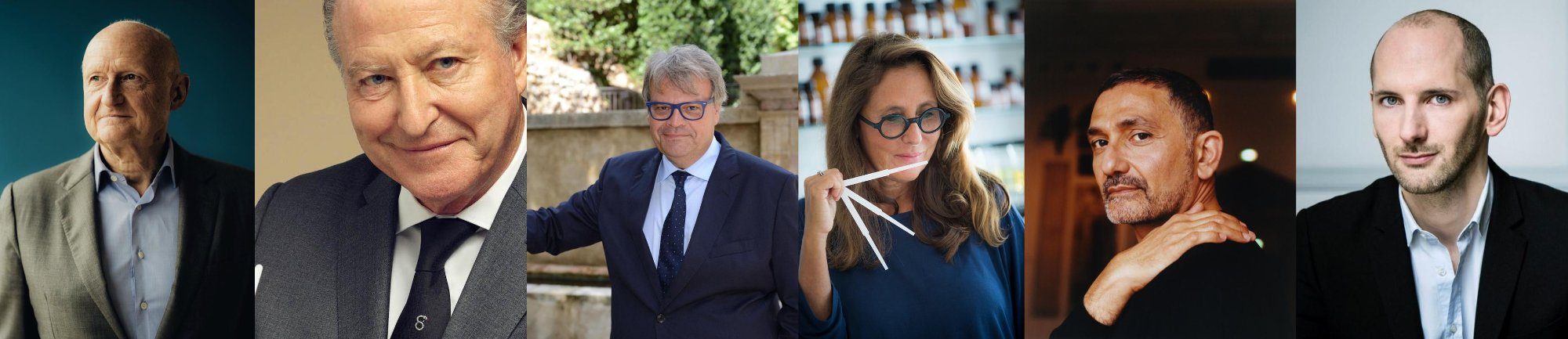
From left to right: Dominique Ropion (IFF), Alberto Morillas (Givaudan), Jacques Cavallier-Belletrud (Louis Vuitton), Christine Nagel (Hermès), Francis Kurkdjian (Dior), Quentin Bisch (Givaudan).
The New GenerationAmong the newer generation, Quentin Bisch stands out. He tells interviewers he came to perfumery sideways, out of music and theatre, by way of a short internship in Grasse he never left. He works for Givaudan, and his credits are widely reported to include Delina for Parfums de Marly, Good Girl for Carolina Herrera, Le Beau Paradise Garden for Jean Paul Gaultier, and fragrances for Amouage’s Exceptional Extraits series. Givaudan does not publish perfumer biographies and the brands rarely name their noses on the bottle, so take all of that as the trade press has it rather than as company record. His approach, as he describes it, is to compose a fragrance the way a director stages a performance: strong ideas, careful construction, surprising effects.
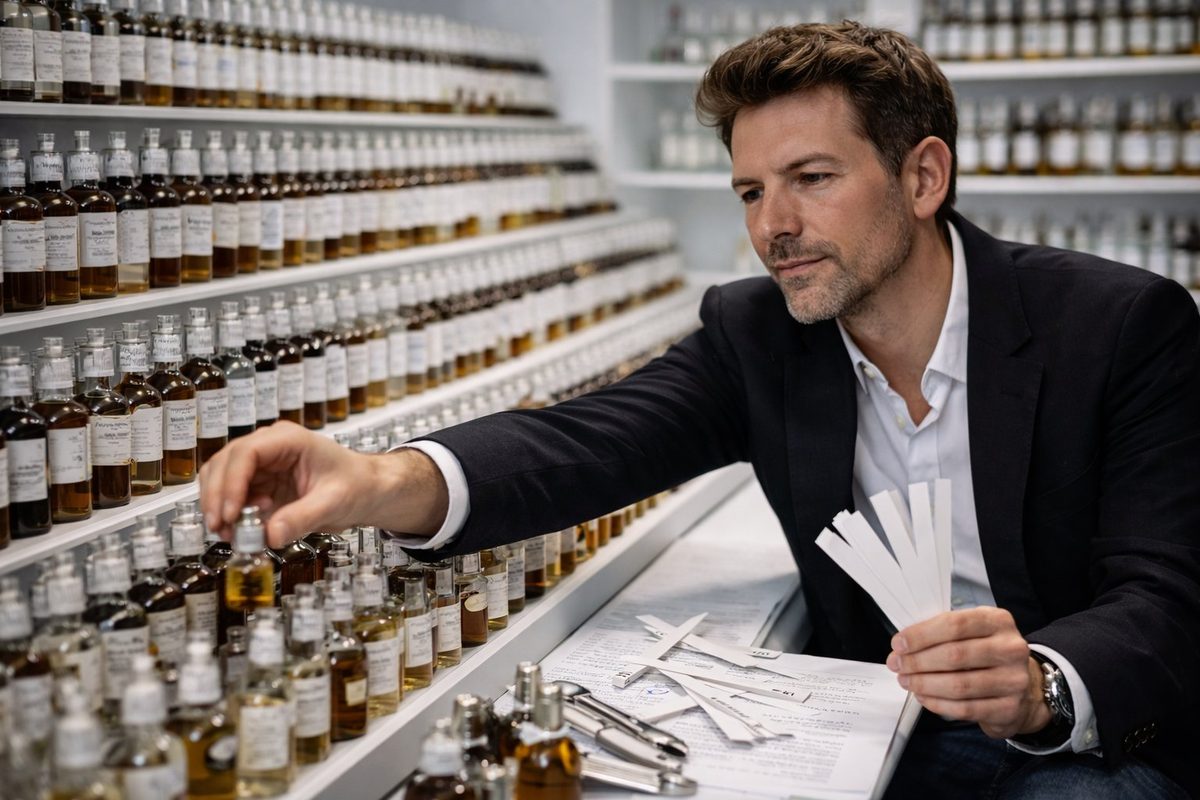
A perfumer’s palette runs to a few thousand individual ingredients. Creating a fragrance can take years.
4. Natural vs Synthetic Ingredients
The Case for NaturalsThere is a persistent idea that natural fragrance ingredients are inherently better than synthetic ones. It’s worth unpacking, because the reality is more interesting.
Natural ingredients are irreplaceable in many ways. The depth, complexity, and living quality of a genuine Bulgarian rose absolute or real oud oil from Assam is something no synthetic has fully replicated. Naturals carry the variation of their terroir. The same ingredient grown in different regions smells subtly different, just like wine grapes do.
The Case for SyntheticsBut synthetics are not the enemy. Many are essential. Ambroxan is one of the molecules that gives real ambergris its smell, formed when ambrein oxidises, but the perfumery material is not scraped off a beach: it is made from sclareol out of clary sage. It is responsible for the skin-close warmth and sillage of dozens of modern fragrances. Iso E Super gives cedar a creamy, shimmering quality that natural cedarwood oil cannot match. It is a woody, slightly smoky aroma chemical, technically an acetyl octahydronaphthalene rather than anything cedar-derived, and in practice a mixture of isomers; IFF patented it in 1975, and it is one of the reasons certain fragrances feel magnetic on skin. Musks, in their natural form, come from endangered animals. Synthetic musks allow those animals to exist undisturbed.
Synthetics also solve a practical problem. Some natural ingredients, oakmoss for example, a foundational note in classic chypre fragrances, are now heavily restricted by IFRA (the International Fragrance Association) on dermal sensitisation grounds, and the EU has gone further, banning outright the two sensitisers oakmoss carries, atranol and chloroatranol. Without synthetic alternatives, entire fragrance families would disappear.
Captive MoleculesSome houses go further. They develop and patent captive molecules: ingredients available exclusively to their perfumers that competitors cannot use. Firmenich’s Ambrox and Clearwood, Givaudan’s Akigalawood. These exclusive ingredients become part of a house’s signature and create a competitive moat that no clone can fully cross.
The best fragrances blend both naturals and synthetics. Knowing this makes you a more informed wearer and more skeptical of marketing that treats “all-natural” as a synonym for superior.
5. Fragrance Families
Every fragrance belongs to a family, a broad category that describes its dominant character. Understanding families helps you discover what you like and why.
FougèreThe word means “fern” in French, which is ironic because fern has no real smell. Fougère is a constructed accord: lavender, coumarin, oakmoss, and bergamot. It was invented by perfumer Paul Parquet for Houbigant’s Fougère Royale, which Houbigant itself dates to 1882 while other accounts put the launch at 1884, and it became the backbone of what most people imagine as classic men’s fragrance. Parquet built it around coumarin taken from the tonka bean, which is why it is usually named as the first perfume composed around a synthetic aroma material rather than an imitation of a natural one. Drakkar Noir, Azzaro Pour Homme, and Brut are all fougères. Clean, green, and quietly authoritative. You should clarify with yourself whether you know what a fougère actually smells like before you claim to love or dislike it. Most people who say they hate it have been wearing it for decades without knowing.
ChypreNamed after Cyprus, chypre is built on the tension between bergamot up top and oakmoss, patchouli, and labdanum — the resin of the cistus rockrose — underneath. Earthy, mossy, and sophisticated. François Coty invented the modern chypre in 1917 with his fragrance also called Chypre. Mitsouko, which Jacques Guerlain composed in 1919, is the canonical example. Chypres lost ground as oakmoss came under restriction, first through IFRA’s own standards and then through an EU ban on two of its allergenic constituents, atranol and chloroatranol, adopted in 2017 and biting from 2019. They remain one of the most respected fragrance families among serious collectors.
Oriental / AmberWarm, rich, and resinous. Amber accords, vanilla, musks, and spices anchor this family. Think Shalimar by Guerlain, Opium by YSL, Obsession by Calvin Klein. They tend to project strongly and last a long time. In warm weather they can overwhelm. In cold weather they are perfectly suited.
Oud / ArabicOud deserves its own category at this point. Once niche even in the niche world, it has been one of the defining materials in Western perfumery for the better part of two decades. True oud is dark, smoky, and animalic: one of the most complex materials in perfumery. Amouage, founded in Muscat in 1983 and still the best known Omani house, built its identity on it, and British houses like Clive Christian and Roja Parfums have leaned on it just as hard. Western houses from Tom Ford to Dior now offer oud flankers. The quality varies enormously. Agarwood only forms when an Aquilaria tree is infected and floods its heartwood with resin in response, and every Aquilaria species has been CITES-listed since 2004. Real oud is expensive for good reason.
Aromatic / Modern FougèreHerbs: rosemary, sage, thyme, juniper, blended with woods and citrus. Fresh but grounded. Terre d’Hermès is perhaps the most celebrated modern aromatic. Practical, versatile, and approachable for daily wear.
Fresh / Citrus / AquaticLight, clean, and immediate. Bergamot, lemon, grapefruit, sea salt, green notes. CK One started the unisex fragrance era in 1994. These fragrances tend to have lower longevity because their top-heavy citrus and aquatic molecules simply evaporate faster than resins or musks. Citrus molecules are volatile by nature. That brightness you love in the first five minutes is exactly why it doesn’t last five hours. They trade longevity for immediate impact and universal wearability in warm weather.
FloralThe largest fragrance category by volume. Rose, jasmine, lily, iris, tuberose. The range within florals is enormous, from powdery old-school to sharp modern soliflores. Not exclusively feminine, despite assumptions. Frederic Malle’s Portrait of a Lady and Serge Lutens’ Sa Majesté La Rose are worn by men who know what they are doing.
GourmandSweet, edible-smelling fragrances built on vanilla, caramel, chocolate, coffee, and pastry notes. Angel by Thierry Mugler, launched in 1992 and still described by the house itself as the first gourmand perfume, invented the category. Either you love gourmands or you don’t. There is rarely a middle ground.
Animalic NotesAnimalic notes deserve their own mention because they sit outside any single family but appear across many of them. Ambergris is a waxy substance produced in the digestive system of sperm whales and occasionally washed up on beaches. For centuries it was one of the most prized fixatives in perfumery, giving fragrances warmth, depth, and remarkable staying power. Today it is largely replaced by ambroxan, a synthetic built up from the sclareol in clary sage that reproduces the key odorant of ambergris, for reasons both ethical and regulatory. Civet and musk went the same way: the civetone in a modern perfume is synthesised rather than taken from a civet, and essentially all perfumery musk is now synthetic. Castoreum, from the beaver, is the holdout, still used in small quantities in a handful of classic formulas. Most people wearing a “musky” fragrance today are wearing molecules that were never near an animal.
6. Understanding Concentrations
The Concentration ScaleThe concentration of fragrance oil in a bottle determines how strong, how long-lasting, and how differently a scent performs. These aren’t just marketing distinctions; they genuinely change the experience.
- Eau de Cologne (EDC): roughly 2–4% fragrance oil. Light and refreshing. Lasts 1–2 hours. Think of it as a splash, not a statement.
- Eau de Toilette (EDT): 5–15%. The workday standard. Moderate projection, 3–5 hours of wear. Better for warm weather and casual contexts.
- Eau de Parfum (EDP): 15–20%. Richer and longer-lasting. 5–8 hours. The sweet spot for most serious fragrance wearers.
- Parfum / Extrait de Parfum: 20% and up, sometimes considerably higher. Maximum concentration. Applied in small amounts, it can last all day and well into the next. More intimate sillage: it stays close to the skin rather than filling a room.
Treat those ranges, and the hours attached to them, as conventions rather than rules. None of these terms is legally defined anywhere, houses set their own thresholds, and an EDT from one house can carry more concentrate than an EDP from another. The hour figures are my own rule of thumb, not an industry standard.
Oils, Attars and BakhoorTwo other formats worth knowing: fragrance oils and attars sit outside the alcohol-based classification entirely. Attars are oil-based perfumes with roots in Indian and Middle Eastern tradition, often extremely concentrated and long-lasting because oil bonds differently to skin than alcohol does. They do not project the same way but they linger. Many of the oldest and most revered fragrances in the world exist only as attars.
Bakhoor is the Arabic and Middle Eastern tradition of burning wood chips or resins that have been soaked in fragrance oils, typically in a traditional incense burner called a mabkhara. Oud chips, blended with rose, amber, and musk, are the most common form. The smoke scents the air, the clothes, and the hair in a way that no spray can replicate. It is an entirely different relationship with fragrance: ambient, communal, and deeply rooted in hospitality culture across the Gulf. If you have never experienced bakhoor, it belongs on your list.
The Elixir CrazeThe modern Elixir format was effectively launched by Dior Sauvage Elixir, composed by François Demachy and sold on the strength of its concentration. It won Fragrance of the Year in the Men’s Luxury category at the Fragrance Foundation Awards in 2022 and triggered a wave of Elixir releases from houses across the industry.
What makes an Elixir different from a Parfum is not simply concentration. An Elixir is typically a full reformulation, often darker, richer, and more animalic, that reimagines the original scent rather than just intensifying it. The Sauvage Elixir smells more like a cousin of the original than a concentrated version of it. That distinction matters.
The Elixir format has become a serious revenue driver for luxury houses. It allows established bestsellers to be repositioned as ultra-premium products at higher margins. For the consumer, an Elixir can be a real step up. It can also be an expensive way to own a heavier version of something you already have. Sample before committing.
Parfum formats are widely described as the fastest-growing segment in the fragrance market, with figures floating around 8% annual growth, though that number is more of an industry approximation than a figure tied to any specific named market report. Either way, the direction of travel in the industry is clearly upward in concentration and price.
7. The Rise of the Clones
The Clone MarketOne of the most significant shifts in fragrance over the past decade has been the explosion of clone fragrances: affordable alternatives that closely replicate the character of expensive originals.
Houses like Lattafa, which runs out of Sharjah in the UAE, Fragrance World, and the California-based Alexandria Fragrances have built substantial businesses by offering scents that smell remarkably similar to Tom Ford, Creed, or Initio at a fraction of the price. A bottle that costs $400 at a department store has a clone on Amazon for $25.
The fragrance community is divided on this. The purist position is that clones undermine the artistry and investment behind original creations. The pragmatist position is that fragrance should be accessible, and clones democratize that access. Both have merit.
What is certainly true is that the clone market has raised the quality floor of affordable fragrance dramatically. A well-made Lattafa EDP performing for 8 hours at $20 a bottle has changed what budget-conscious consumers expect. It has also pushed luxury houses to differentiate more aggressively on ingredients, storytelling, and the retail experience, because performance alone is no longer a sufficient moat.
My TakeFor me personally, clones are the gateway drug. They give you enough of the original to make you crave the real thing. Every clone I have bought has eventually made me want the bottle it was inspired by. That is probably the opposite of what budget-minded buyers intend, but it is what actually happens.
For someone new to fragrance, clones are a useful educational tool. They let you understand a scent profile before committing to a luxury bottle. For someone building a collection, the originals matter, both for their craftsmanship and for the fact that reformulations of popular clones happen far less often than reformulations of the originals they copy.
8. Fragrance and the Human Body
Skin ChemistryWhy does the same perfume smell different on different people? The answer is skin chemistry.
Your skin’s pH, natural oils, body temperature, and microbiome all interact with fragrance molecules and alter how they develop. A citrus top note that disappears in minutes on one person can linger for an hour on another. An oud base that smells powerfully smoky on one skin smells warm and woody on another. This is why a friend’s recommendation, however well-intentioned, is only a starting point.
Diet is often said to play a role too, though the specific claim that high-fat diets make a fragrance project harder is one I have not been able to trace to any controlled study. What is easier to observe is that hydrated skin holds fragrance longer than dry skin. Applying unscented moisturizer before spraying creates a base that extends wear noticeably.
Scent and MemoryThen there is the scent-memory connection. The olfactory system connects directly to the hippocampus and amygdala, the brain’s memory and emotion centers. No other sense routes this way. This is why a smell can trigger a fully formed emotional memory in an instant, without conscious thought.
DS & Durga’s Radio Bombay does this to me every time. One spray and I am back in my grandmother’s home in Chennai, the smell of her sandalwood chest in the corner of the bedroom. I have not been in that room in decades. The fragrance puts me there in seconds. When I smell Ralph Lauren Polo Green, I think of my father. Chanel No. 5 will always remind me of my mother. These associations formed on their own, quietly, over years. I never chose them.
Some perfumers design with this intentionally, structuring a composition around the associations they hope it will lay down. Frédéric Malle’s house exists to give perfumers the room to work that way: Dominique Ropion took Carnal Flower through 690 iterations before it was signed off. That is the ambition at the highest level of the craft.
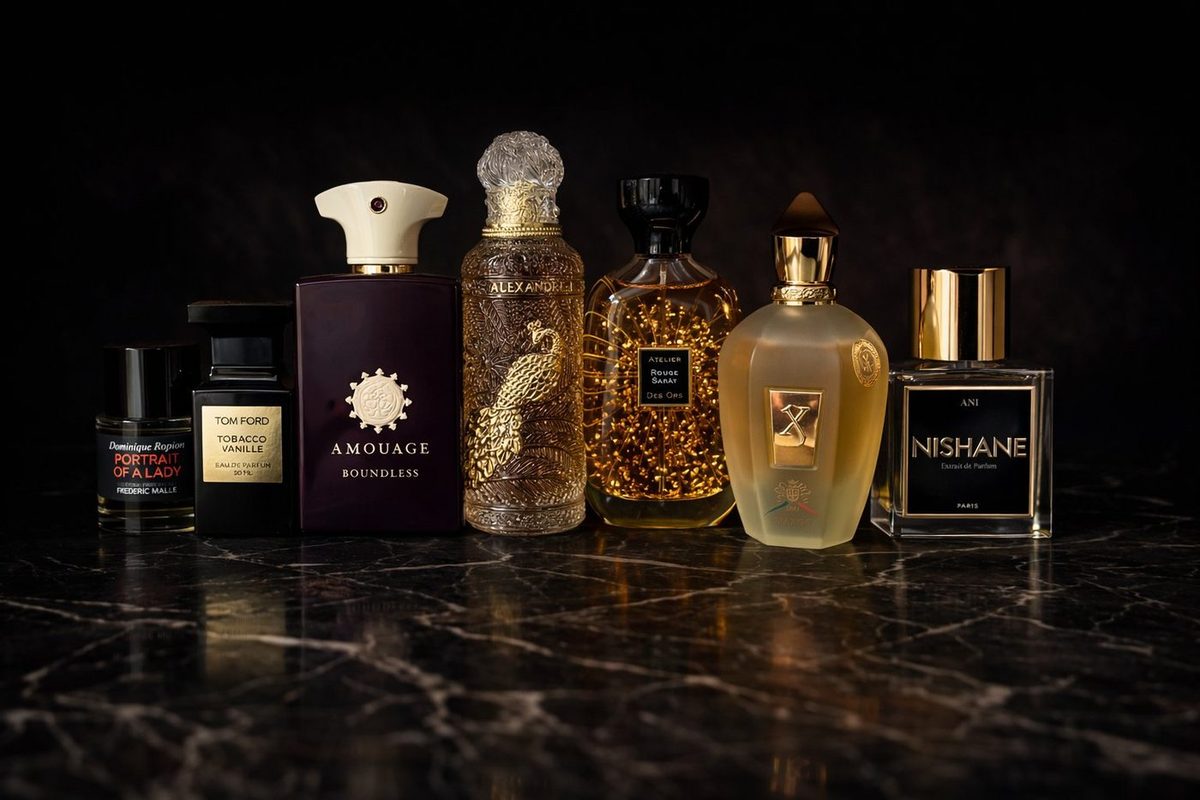
From left to right: Frédéric Malle Portrait of a Lady, Tom Ford Tobacco Vanille, Amouage Boundless, Alexandre J Imperial Peacock, Atelier Des Ors Rouge Saray, Xerjoff Naxos, Nishane Ani.
9. Fragrance and the Global Economy
The NumbersThe fragrance industry is large, growing, and structurally important to multiple sectors.
The global perfume market is valued at around $60 billion in 2025 and is projected to approach $100 billion by the mid-2030s. This figure covers personal fragrances only. It excludes scented household products, room fragrances, and personal care products with added scent, which would more than double the number.
Key PlayersThe dominant players are familiar: LVMH (which owns Dior, Givenchy, and Maison Francis Kurkdjian, among others), Chanel, Coty, Estée Lauder, L’Oréal, and Puig. Behind them, a tier of independent ingredient suppliers, Givaudan, dsm-firmenich (formerly Firmenich and DSM), IFF, and Symrise, essentially supply the raw materials and aroma chemicals that the entire industry depends on.
The fastest growth is happening in Asia-Pacific, particularly India and China, as disposable incomes rise and personal grooming becomes a higher priority. The Middle East is widely described as the highest per-capita fragrance spending region in the world, though I have not found public data that establishes it. On total market value the lead sits with Europe rather than North America.
Fragrance is also one of the most recession-resilient luxury categories. An $80 bottle of perfume is still an accessible indulgence for people who cannot afford a $5,000 handbag.
Must-Know FragrancesTwo fragrances worth knowing in terms of commercial scale: Creed Aventus and Dior Sauvage are routinely cited as among the best-selling niche and designer fragrances in the world respectively. Dior Sauvage has been reported to be one of the top-selling men’s fragrances globally for several years running, though rankings of this kind rest on proprietary retail panel data that is never published in full. Creed Aventus commands a price point and following that most niche houses can only aspire to. Both are worth smelling regardless of whether you own them. They became what they are for a reason.
Frederic Malle is worth a separate mention here. His house, founded on the concept of giving named perfumers creative freedom, produces some of the most serious fragrances made today. Portrait of a Lady and Monsieur are two of the best things in my collection. The people behind the Frederic Malle counter are among the most knowledgeable in the business and worth getting to know.
10. Sustainability & the Future
The fragrance industry has a genuine sustainability problem, and the better houses are beginning to address it seriously.
Endangered IngredientsSome of fragrance’s most important naturals are under pressure. Indian sandalwood is assessed as Vulnerable in the wild and its harvest in India is controlled by the state rather than by whoever owns the land; a wild tree needs something like thirty years before the heartwood is worth cutting. Agarwood, the source of oud, is scarce enough in the wild that every species of Aquilaria and Gyrinops has sat on CITES Appendix II since January 2005, with Aquilaria malaccensis listed a decade before that. Ambergris, the waxy substance from sperm whales that produces one of perfumery’s most prized fixatives, is now largely replaced by synthetic ambroxan — for legal reasons as much as ethical ones, since the sperm whale is on CITES Appendix I and has been listed as endangered under United States law since 1970. The industry’s reliance on slow-growing, rare, or animal-derived materials is a structural vulnerability.
Responsible SourcingSome houses are beginning to address this with real commitment. Chanel is long reported to work directly with flower growers in Grasse, the region whose perfume-plant cultivation UNESCO inscribed as intangible cultural heritage in 2018, though the house itself publishes almost nothing about how the arrangement works. Givaudan and dsm-firmenich both publish sustainability reports detailing ingredient sourcing practices.
The most ambitious example in the industry right now is Amouage’s Wadi Dawkah project. Since 2022, Amouage has been the custodian of Wadi Dawkah, a UNESCO World Heritage Site in the Dhofar region of Oman, home to a wild stand of Boswellia sacra whose size is usually given as around 5,000 trees, a figure that recurs across press coverage but that I could not match to any published count. In partnership with Oman’s Ministry of Heritage and Tourism, they have turned the site into what the house itself calls the first smart forest in the GCC, using geotagging and blockchain to trace every harvest from tree to bottle. That description is Amouage’s own and I have not been able to verify it independently. A visitor centre and distillery, designed by Milan-based Giò Forma Studio, is under construction and expected to open in 2027.
Perfumers are invited to sponsor individual trees at the site. I have sponsored one myself.
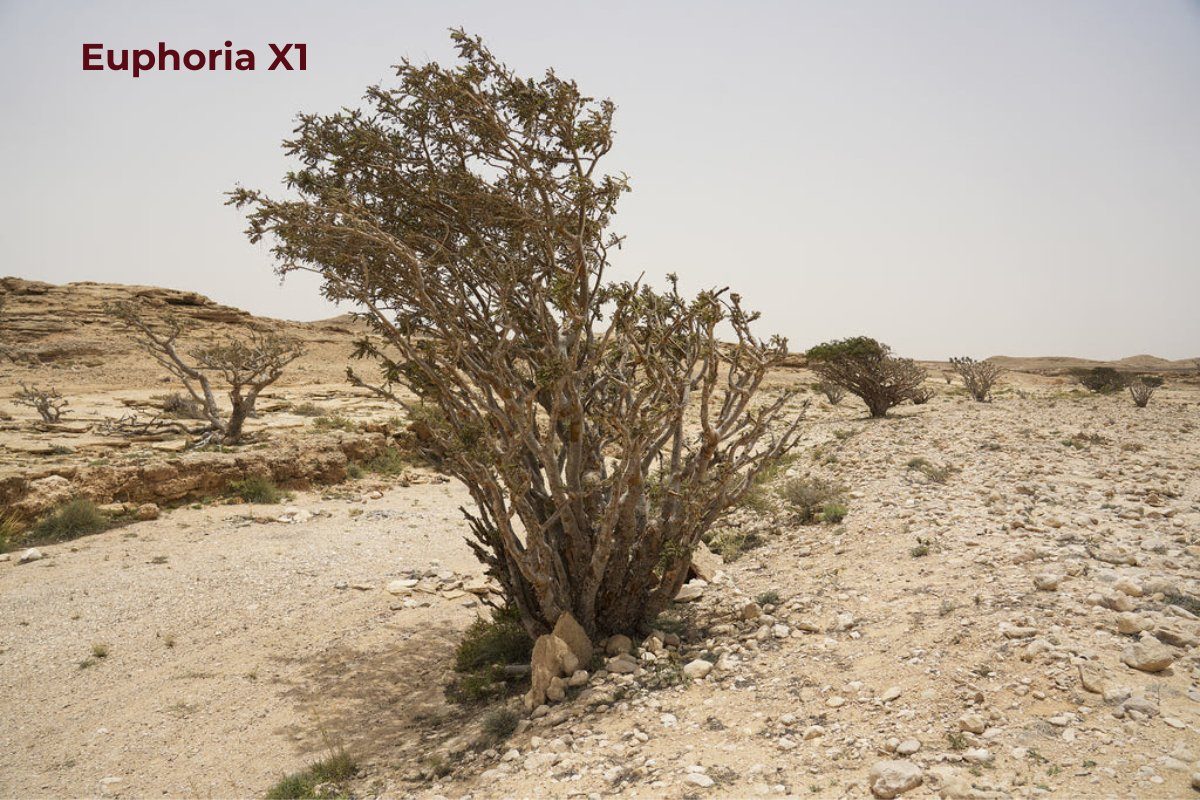
Euphoria X1 — my sponsored frankincense tree at Wadi Dawkah, Oman. One of the Boswellia sacra trees at the UNESCO World Heritage Site, custodied by Amouage since 2022.
Similar programs exist elsewhere. Louis Vuitton runs its perfume operation out of Les Fontaines Parfumées in Grasse, though I could not find a published account of what its sourcing there actually commits to. Givaudan buys through a programme it calls Sourcing4Good, with a 2030 target for responsibly sourced materials and services. These are still the exception, not the rule, but the pressure is growing.
The Packaging ProblemThis is where the industry has the most obvious room to improve, and the least excuse not to. A typical luxury fragrance bottle arrives inside a box, wrapped in tissue, cushioned with filler, sealed with a ribbon. The bottle itself is often glass that weighs more than the liquid it contains. Almost none of it needs to be this way.
Some houses are starting to offer refill programs, selling a refill bottle or pouch instead of a whole new presentation each time. This is a meaningful step. But refills remain the exception rather than the rule.
There is a compelling model in adjacent industries worth adopting more widely. Card companies like Botanical PaperWorks embed wildflower seeds in their paper packaging. The packaging itself becomes something you plant rather than discard. Fragrance houses could easily use seed-embedded paper for outer boxes. Some smaller niche brands already do. The barrier is a willingness to prioritize it, not technology or cost.
Other practical approaches worth wider adoption: biodegradable filler materials, minimal single-material packaging that is easier to recycle, concentrates that reduce liquid volume and therefore shipping weight, and glass standardization that makes bottle reuse more practical.
The consumer side of this equation matters too. Buying fewer bottles of better quality, using what you own before adding more, choosing houses with transparent sourcing and refill programs. A collection of 850 bottles, I will freely admit, is not the most sustainable position. But it starts with knowing the problem exists.
11. Pairing Fragrance with Spirits
Why It WorksThis is where fragrance and the other half of this channel intersect. The parallel is closer than it might seem. Both fragrance and fine spirits are built around layered aromatic complexity. A whisky’s opening, its development on the palate, and its finish map remarkably well onto a fragrance’s top, heart, and base notes. Both reward patience and attention.
General Principles- Match intensity. A heavy, oud-forward fragrance belongs with an equally assertive whisky. A light, fresh EDT gets lost next to something powerful. Mismatches can also work if done deliberately: a medicinal, peaty Scotch can balance a sweet oriental in the same way a sour cuts through richness in cooking.
- Find the shared note. Smoky fragrance with peated Scotch. Vanilla-forward oriental with bourbon. Tobacco accord with aged rum. When both share a dominant aromatic character, they amplify each other rather than compete.
- Think about seasons. Heavy fragrances and heavy spirits are both cold-weather pleasures. In summer, a fresh aromatic EDT pairs more naturally with something lighter: a Japanese whisky, a light rum, a dry gin.
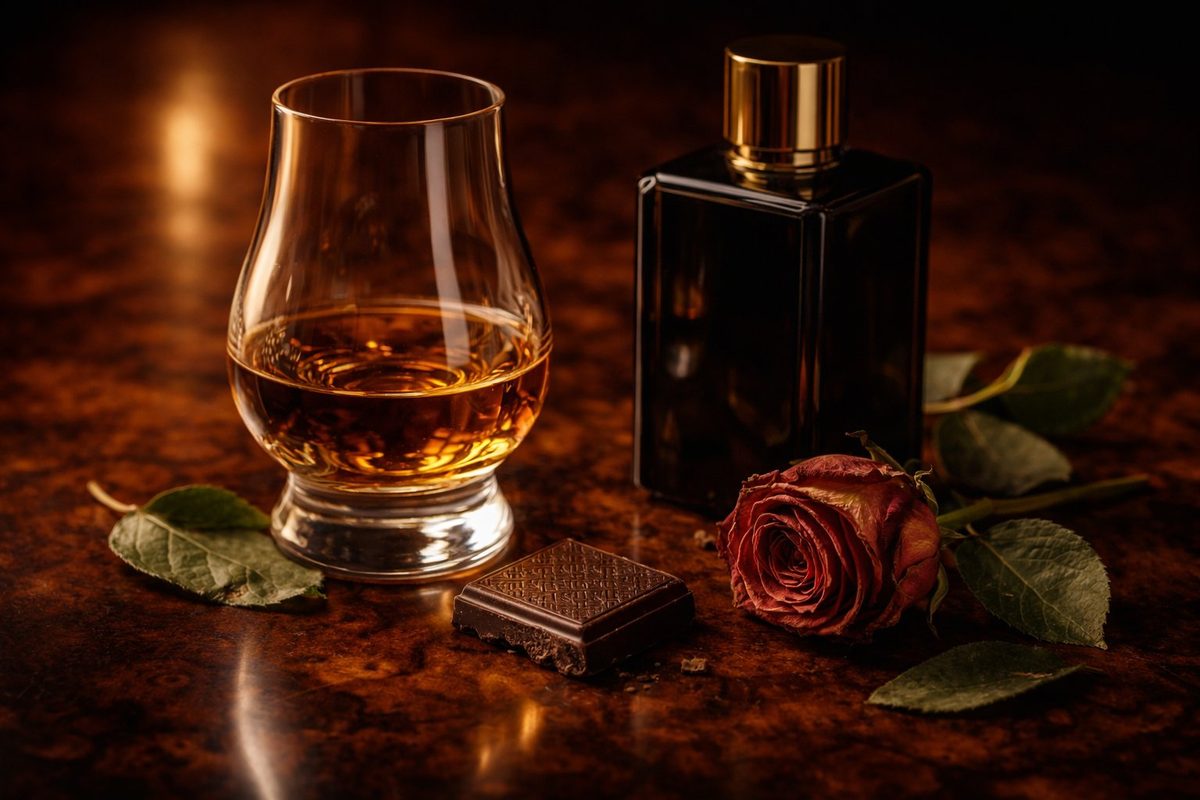 Pairings from My Collection
Tom Ford Tobacco Oud — tobacco, oud, incense, and a boozy warmth in the drydown that reads like whisky, though no listing I can find names whisky as a note. Pairs with Ardbeg Corryvreckan or Ardbeg Smoketrails. Both are peat-forward Islays with enough complexity to match the fragrance’s depth. The smoke in the bottle and the smoke in the glass reinforce each other.
Creed Centaurus — cinnamon, cardamom, bourbon vanilla, tonka. Pairs with Calumet 16 or Woodford Reserve Double Oaked. The vanilla and spice in the fragrance echo the oak-driven sweetness of American whiskey.
Orto Parisi Terroni — birch smoke, volcanic earth, guaiac wood. Pairs with Colonel E.H. Taylor Straight Rye Bottled in Bond or Rittenhouse Rye. Rye’s dry spice and the fragrance’s raw earthiness complement without competing. Both have edge.
Guerlain Habit Rouge — vanilla, rum raisin accord, warm amber. Pairs with Shibui Sherry Cask 18 Year or Aberlour A’bunadh. Sherry-influenced whiskies share the dried fruit and warm spice DNA of oriental fragrances. The pairing feels inevitable once you try it.
Hermès Voyage d’Hermès — cardamom, juniper, cedar. Pairs with Suntory Toki or Shibui 10 Virgin White Oak. Japanese whiskies tend toward elegance and restraint. So does Voyage. Neither dominates. They coexist with the kind of quiet dignity that makes an evening feel considered.
Xerjoff Naxos — honey, tobacco, lavender, tonka, oud. Pairs with FourSquare Sagacity or Ron Zacapa 23. Aged rums have a tropical sweetness and complexity that holds up to a rich oud fragrance. The honey note in Naxos and the molasses character of a good rum create a genuinely memorable pairing.
12. Where Fragrance Goes From Here
What ChangesThe fragrance world in 2026 is more interesting than it has been at any point in recent memory. Social media has created a genuinely global conversation about scent that did not exist fifteen years ago. TikTok’s #PerfumeTok, YouTube reviewers with millions of subscribers, Instagram accounts dedicated to niche collecting: these communities have brought new consumers into the category, elevated houses that previously had no marketing budget, and created demand for transparency about ingredients and sourcing.
The tension between accessibility and exclusivity will define the next decade. Clones will keep improving. Luxury houses will keep pushing prices higher and concentrations richer. The niche market will keep fragmenting into micro-niches. Sustainability will move from a talking point to a requirement as regulation tightens.
What Doesn’tWhat will not change is the fundamental thing. Scent connects to memory in a way nothing else does. A great fragrance, worn at the right moment, becomes part of who you are and how people remember you. That has been true since the first priests of the ancient Near East burned aromatic resins on temple altars, thousands of years ago.
Choose carefully. Wear it with intention.
Appendix: Fragrance Glossary
A reference for the terms used throughout this post. Definitions are practical, not academic.
A highly concentrated aromatic extract obtained by solvent extraction from delicate plant materials like jasmine or rose. More complete and complex than an essential oil. More expensive, and more true to the original flower.
A blend of two or more fragrance materials that together create a single unified impression. A rose accord does not contain actual rose; it is a construction of multiple molecules that smells like rose. Most modern fragrances are built from accords rather than single raw materials.
A descriptor for notes that smell warm, skin-like, musky, or faintly animal. Historically derived from ambergris, civet, castoreum, and musk deer. Now almost entirely replicated synthetically. At low levels, animalic notes add depth and sensuality.
An oil-based perfume with roots in Indian and Middle Eastern tradition. Made by distilling botanicals into a base of sandalwood oil. Extremely concentrated and long-lasting. Many of the world’s oldest fragrances exist only as attars.
The final layer of a fragrance, emerging after the top and heart notes have faded. Woods, resins, musks, and ambers dominate here. Base notes provide longevity and anchor the entire composition. They are what linger on skin hours later.
A synthetic aroma chemical developed and patented exclusively by one fragrance supplier. Available only to perfumers who work with that supplier. Akigalawood and Clearwood are two commonly cited examples, though which supplier holds which is worth checking rather than assuming. Captive molecules give houses a signature that competitors cannot fully replicate, and only for as long as the protection lasts: once a patent lapses the material becomes generally available.
A fragrance family built on the accord of oakmoss, labdanum, bergamot, and cistus. Earthy, mossy, and sophisticated. Named after Cyprus. François Coty defined the modern chypre in 1917. Heavily affected by IFRA restrictions on oakmoss since the 2000s.
A fragrance that closely replicates the character of an existing, usually more expensive original. Not a counterfeit: clones are openly marketed as inspired by their reference. Houses like Lattafa, Fragrance World, and Alexandria Fragrances specialize in this category.
The percentage of fragrance oil in a bottle relative to alcohol and water. The percentage bands used below are industry convention rather than a legal definition; no regulation fixes them. Higher concentration generally means more intensity, longer longevity, and closer sillage. See EDC, EDT, EDP, Parfum, and Elixir.
The final stage of a fragrance’s development on skin, typically 30 minutes to an hour after application, when the top notes have fully evaporated and the base notes have settled. The dry down is often the truest expression of a fragrance and the most important phase to evaluate before buying.
2–4% fragrance concentration. Light, fresh, short-lived. Lasts 1–2 hours.
15–20% fragrance concentration. Rich, long-lasting. 5–8 hours. The most popular format among serious collectors.
5–15% fragrance concentration. The standard workday format. Moderate projection, 3–5 hours of wear.
A reformulated, ultra-concentrated version of an existing fragrance, positioned above Parfum in strength. Not simply a higher concentration of the original: typically a darker, richer reinterpretation. Dior Sauvage Elixir (2021) is often cited as the trend's starting point, though search interest in "elixir perfume" didn't spike until 2023 and several houses launched Elixir-tier fragrances around the same time, so credit is better described as shared than singular.
20–40% fragrance concentration. Maximum strength. Intimate sillage. Long-lasting and expensive. Applied in small amounts.
An ingredient that slows the evaporation of other fragrance materials, extending longevity and anchoring the composition. Ambergris was historically the most prized natural fixative. Synthetic ambroxan now serves this purpose in most modern fragrances.
A new fragrance released by a house that is related to an existing one, sharing DNA but not identical. Sauvage EDP is a flanker of Sauvage EDT. Flankers allow brands to extend successful franchises without replacing the original.
A constructed fragrance accord and family built on lavender, coumarin, oakmoss, and bergamot. Invented in 1882. The backbone of classic masculine fragrance for over a century. The name means “fern” in French, despite fern having no meaningful scent.
A fragrance family built on edible-smelling notes: vanilla, caramel, chocolate, coffee, pastry. Angel by Thierry Mugler (1992) created the category. Polarizing but commercially dominant.
The core of a fragrance, emerging as top notes fade, typically 20–60 minutes after application. Florals, spices, and resins dominate this layer. Heart notes define the fragrance’s character and personality.
The International Fragrance Association. The industry body that sets usage guidelines and restrictions for fragrance ingredients based on safety and allergen research. IFRA restrictions, and in the EU outright bans on certain constituents, have significantly limited or eliminated certain classic natural ingredients, including oakmoss and several musks, forcing reformulations of many historic fragrances.
How long a fragrance lasts on skin. Affected by concentration, skin type, application method, and the specific materials used. Resins, musks, and woods generally last longer than citrus and aquatic notes.
Fragrance produced by an independent or artisan house, typically in smaller quantities, with a focus on ingredient quality and creative vision over mass-market appeal. Amouage, Frederic Malle, Serge Lutens, and Creed are examples. The line between niche and luxury designer has blurred considerably.
The informal title for a master perfumer. Refers both to the physical organ and to the trained ability to identify, remember, and creatively combine thousands of aromatic materials. It is often said there are fewer working noses in the world than there are astronauts, though I have never found a hard count behind the line.
A single aromatic component or impression within a fragrance. Notes are described in three layers: top (first impression, fades quickly), heart (the core character), and base (the lasting foundation). A fragrance may contain dozens of individual ingredients but be described by only three or four marketing notes.
A dark, resinous material produced by the agarwood tree after wounding, when the wood is colonised by fungi. Not one specific mould: studies of infected trees isolate dozens of fungal associates across several genera. One of the most expensive raw materials in the world. The word comes from the Arabic al-oud, meaning the wood. Central to Middle Eastern and Arabic perfumery for centuries. Now ubiquitous across niche and luxury Western fragrance.
How far a fragrance radiates from the skin into the surrounding space. High projection means others will smell you from a distance. Low projection means the fragrance stays close and personal. Neither is inherently better; it depends on context and intention.
A change to an existing fragrance’s formula, often driven by ingredient restrictions, cost pressures, or supplier changes. Reformulations are common and frequently controversial. Many classic fragrances smell different today than they did decades ago. Earlier vintages are often sought after by collectors as a result.
The trail a fragrance leaves in the air as you move through a space. From the French word for “wake” (as in the wake of a ship). A fragrance with strong sillage announces itself. One with low sillage stays close. Related to but distinct from projection: projection is about how far it radiates outward; sillage is about the trail left behind.
A fragrance built around a single flower note, intended to represent that flower as accurately as possible. A rose soliflore aims to smell like rose and little else. Increasingly rare in commercial perfumery, where complexity and blending are the norm.
Borrowed from wine. In fragrance, terroir refers to how the geographic origin of a natural ingredient affects its smell. Bulgarian rose smells different from Turkish rose. Haitian vetiver smells different from Javanese vetiver. Origin matters, and the best houses source accordingly.
The first impression of a fragrance, immediately apparent on application. Citrus, herbs, and light florals dominate this layer. Top notes evaporate quickly, typically within 15–30 minutes. They invite you in but do not define the fragrance. Never buy a bottle based on top notes alone.