The second SSS event was at the Amateur Comedy Club in Murray Hill, founded in 1884 and, by its own account, the oldest continuously performing theatre group in America. The room has hosted actors, writers, and artists for over a century. It felt like the right place to do this properly.
Seven whiskies. Seven regions. A cocktail built for each one. And at the end, something I’ve been working on since the first time I tasted Laphroaig and started wondering what it wanted to become.

SSS Events — A Two-Part Series
4. Why Whisky Is the World’s Most Storied Spirit
No other spirit carries place the way whisky does. A bourbon from Kentucky, a pot still from Cork, a single malt from Islay. You can taste where it came from. The peat in the bog, the grain in the field, the wood from a barrel that used to hold sherry. Whisky is geography you can drink.
It also rewards time. Not just years in the cask, but years spent drinking across regions and paying attention. The more you taste, the more each bottle starts making sense on its own terms. That’s what this evening was designed to do.
We went new world to old, easy to demanding. Buffalo Trace first, because everyone can agree on it. Laphroaig last, because half the room won’t. Seven countries, seven different ideas about what whisky should be.
5. The Seven Whiskies
Reportedly the oldest continuously operating distillery in America, though rivals dispute the title. Frankfort, Kentucky, on the site where buffalo once crossed the Kentucky River. Leestown was settled there in 1775, and accounts of distilling on the site run from that year, though the distillery’s own history dates whiskey stored there to 1811 and a distillery proper to 1858. They made it through Prohibition by getting a permit to produce medicinal whiskey. Smart.
Buffalo Trace goes first because it argues with nobody. Vanilla, caramel, new American oak. Clean and honest. It sets the reference point. Everything else gets measured against it.
Single pot still is Ireland’s own style. Malted and unmalted barley in the same mash. The unmalted barley gives it an oily texture and a spice you won’t find in Scotch. Redbreast is the one people point to when they want to show what the style can do.
The name comes from the robin redbreast: a nickname given by a W&A Gilbey chairman who was an amateur birdwatcher, first used on the bottle in 1912. Matured in bourbon and Oloroso sherry casks. Orchard fruit, toasted wood, cream. A few people at the table that night said they didn’t drink Irish whiskey. They have since reconsidered their opinions.
Goa, foot of the Western Ghats. Six-row barley from the Himalayan foothills. The tropical climate compresses maturation: the heat drives the spirit into the wood faster, and the angel’s share runs 8 to 10 percent a year against 2 to 3 in Scotland. What’s left is concentrated beyond its age.
Brilliance is their unpeated flagship. Tropical fruit, honey, light spice. It’s one of the most drinkable single malts from any country. India is producing some of the most interesting whisky in the world right now. Paul John is one of the reasons people started paying attention.
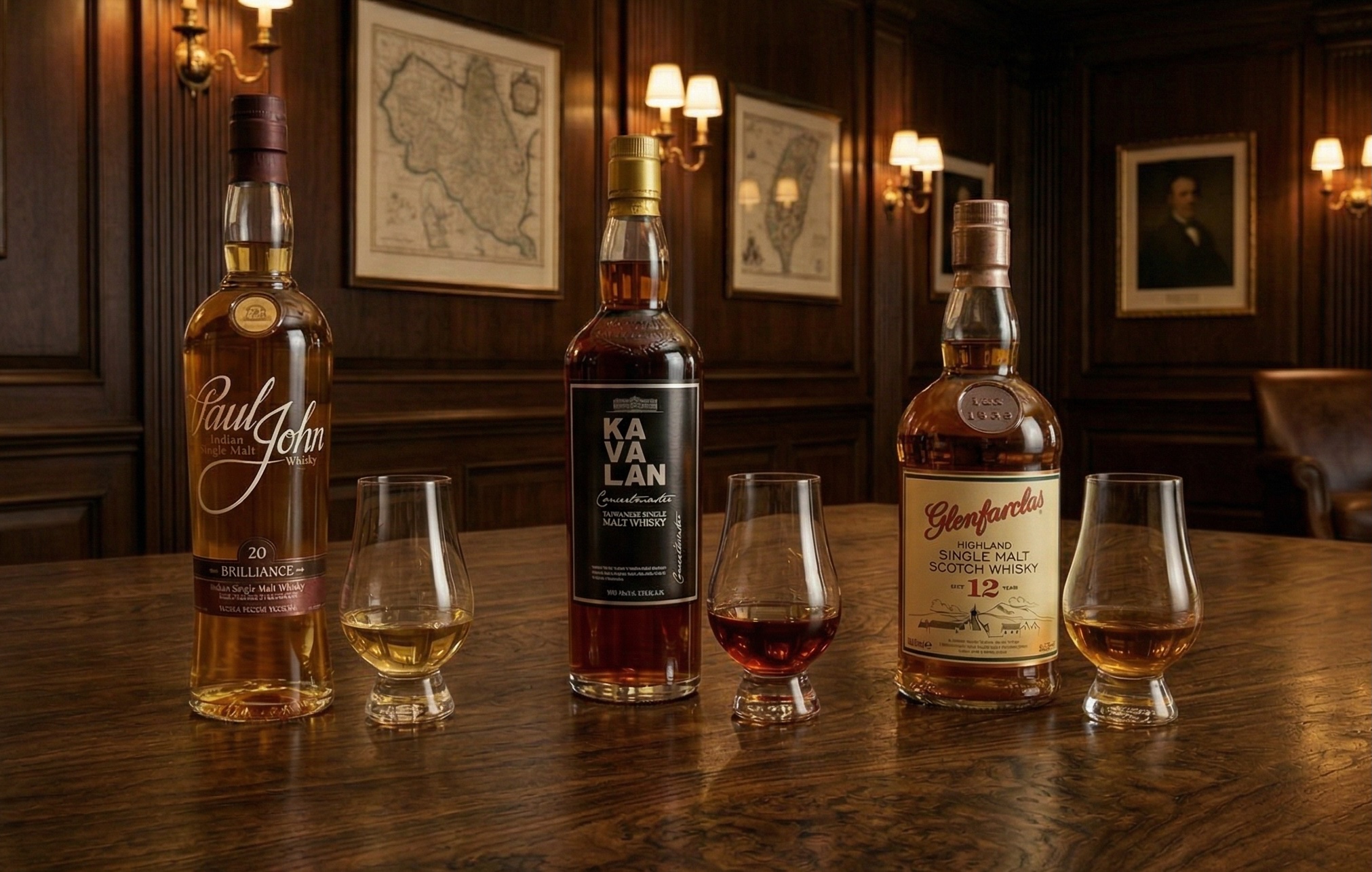
Yilan Valley, northeast Taiwan. Founded in 2005. Same fast-maturation story as India, different terroir, different character. Kavalan collected international awards fast. In a 2010 blind tasting held in Leith, one of its whiskies beat three Scotches and an English malt, and its Vinho Barrique took World’s Best Single Malt at the 2015 World Whiskies Awards. That stopped being surprising a while ago.
The Concertmaster is finished in Port casks. Red berries, dark chocolate, tropical fruit. Generous and uncomplicated. The room agreed on this one without much debate.
Grant family, Speyside, 1865. One of the last independent distilleries in a region that’s been largely swallowed by conglomerates. They mature in ex-Oloroso sherry casks rather than the ex-bourbon wood most distilleries lean on. That’s expensive. Glenfarclas doesn’t cut that corner.
Dried fruit, toffee, a hint of smoke. Rich and fruit-forward. I’ve watched people who said they don’t like whisky finish this glass and ask what it was. That happens more with Glenfarclas than almost anything else I pour.
Malt and grain whiskies married together, then put back into cask to rest. Bottled at 51.4%. Masataka Taketsuru trained in Scotland from 1918 to 1920, brought everything back to Japan, and spent the rest of his life building one of the great whisky companies. He thought whisky should be drunk at full strength. Nikka From The Barrel is the evidence.
Spice, oak, dark chocolate. At 51.4%, it can take the ice or the dilution, and still show you what it is. The complexity doesn’t disappear. It just slows down.
Islay, 1815. The peat bogs the barley is dried over have been forming since the glaciers retreated, at roughly a millimetre a year. The iodine note is usually credited to the distillery’s position on the shore, though what actually carries it is the phenol picked up in the peat kiln. Laphroaig has held a Royal Warrant since 1994, granted back when King Charles III was still Prince of Wales, which makes him the world’s most prominent fan of something that smells like a hospital on a beach. Affectionately.
You will love this or you won’t. There is no middle ground. I have put this glass in front of enough people to say that with confidence. Half the room leans in. Half leans back. Neither reaction is wrong.
6. The Cocktails & The Kannan
Seven whiskies, seven cocktails. One classic format matched to each bottle. Then The Kannan.
The 1806 definition of the word cocktail — spirit, sugar, water, bitters — is this drink. The name Old Fashioned only reaches print in 1880, when drinkers started asking for it the old-fashioned way. That’s the original formula, before cocktail meant anything more complicated. Buffalo Trace handles it well. Vanilla, caramel, no drama.
Ginger beer leans into the spice in Redbreast. The lime echoes the fruit. It’s the cocktail you hand someone who says they don’t drink whisky. Works every time.
Paul John’s tropical fruit makes the whisky sour format sing. Maple syrup instead of simple syrup because it adds raw depth that white sugar doesn’t. It fits the terroir. Named for the city.
Port cask, Cointreau, and orange juice are all working the same frequency. Fruit-forward, a little sweet. The lemon keeps it honest. Named for the sunsets over Taipei’s mountains, which are genuinely something.
The Manhattan’s Scottish cousin. Usually said to be named after Rob Roy MacGregor, though the name most likely came from the 1894 Broadway operetta about him, with the drink credited to the Waldorf-Astoria nearby. Difford’s notes competing accounts. Glenfarclas’s sherry does something good to the vermouth. Stirred, not shaken. Served up. No shortcuts.
The Japanese highball is its own discipline. Ice size, glass temperature, water ratio. Nikka at 51.4% handles the dilution without disappearing. The yuzu is optional.
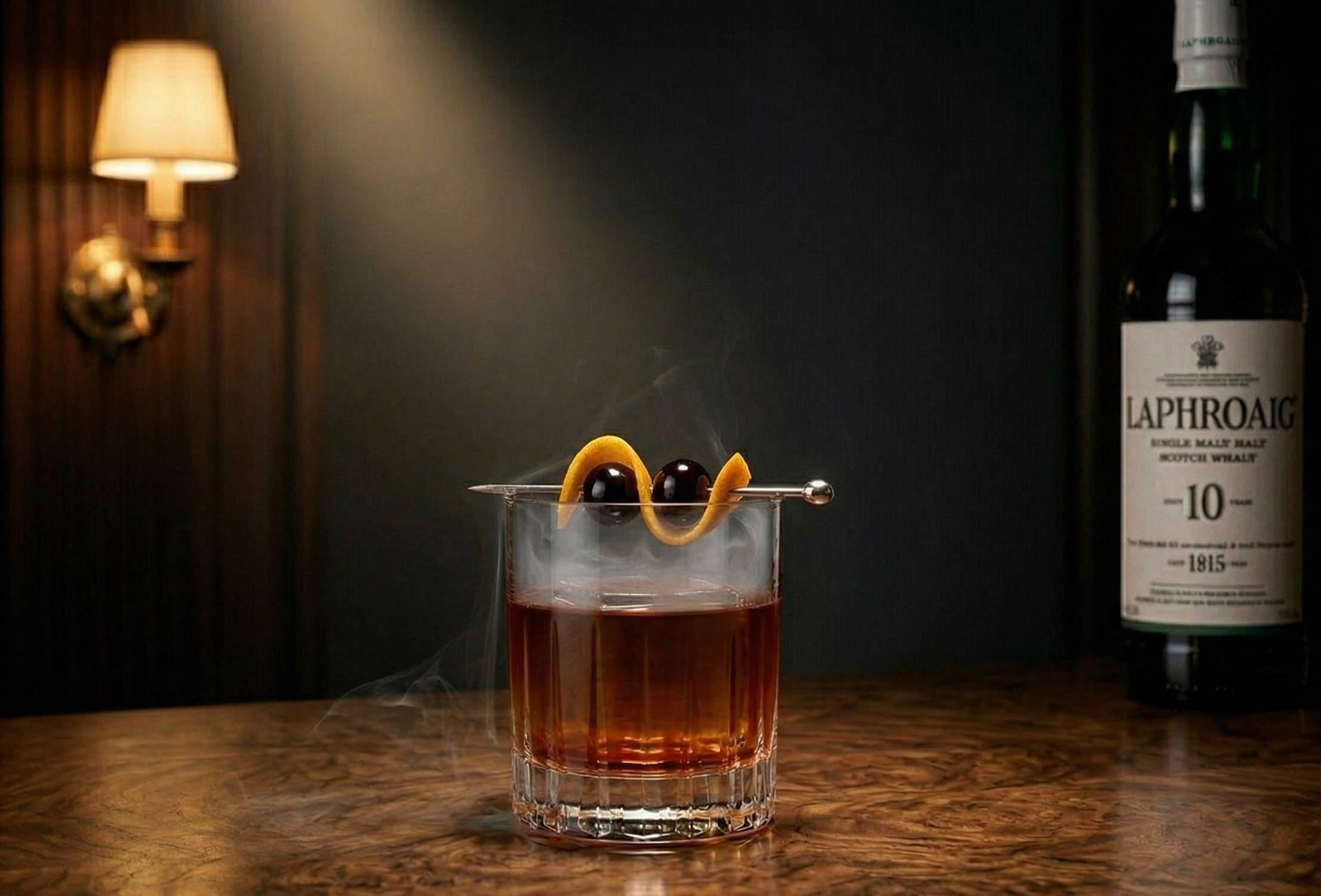
Old Fashioned bones, taken further. Demerara sugar instead of white because the molasses depth matters. Buffalo Trace as the base. A splash of Laphroaig for peat and smoke, just enough to shift the character without taking over. Apple cherry wood smoke ties it together, the sweetness softening the peat’s edge. Two Angostura cherries. Classic finish.
I’ve been working on this for a while. The Amateur Comedy Club is where it finally felt done. If you make it, let me know what you think.
Bring This to Your Table
Both evenings were produced under The Society Table, the SSS curated tasting experience. We select the spirits, design the serving order, build the cocktail pairings, and produce the printed cards. The format is flexible. A curated lineup you run yourself, or a fully hosted evening with presentation. Private dinners and corporate events both welcome. More events coming. Watch the Journal and social channels.
Get in touch at sales@societyofscentsandspirits.com.