SSS Events · Complete Article

Digestifs & Whisky: Two SSS Events

April 10, 2026

SSS Events — A Two-Part Series Part 1: An Evening of Digestifs · Part 2: A Journey Through Whisky · Back to Journal
Read This Bite-Sized →
An illustration representing the complete Digestifs and Whisky SSS Events series

Contents

Part 1


1. Why Serving Order Matters

A good meal needs a proper ending. Not just dessert but something that tells the room the night has shifted. Digestifs have done that job for centuries, in monasteries, in restaurants, in private clubs, and at the kind of dinner parties where people actually care about what they’re drinking.
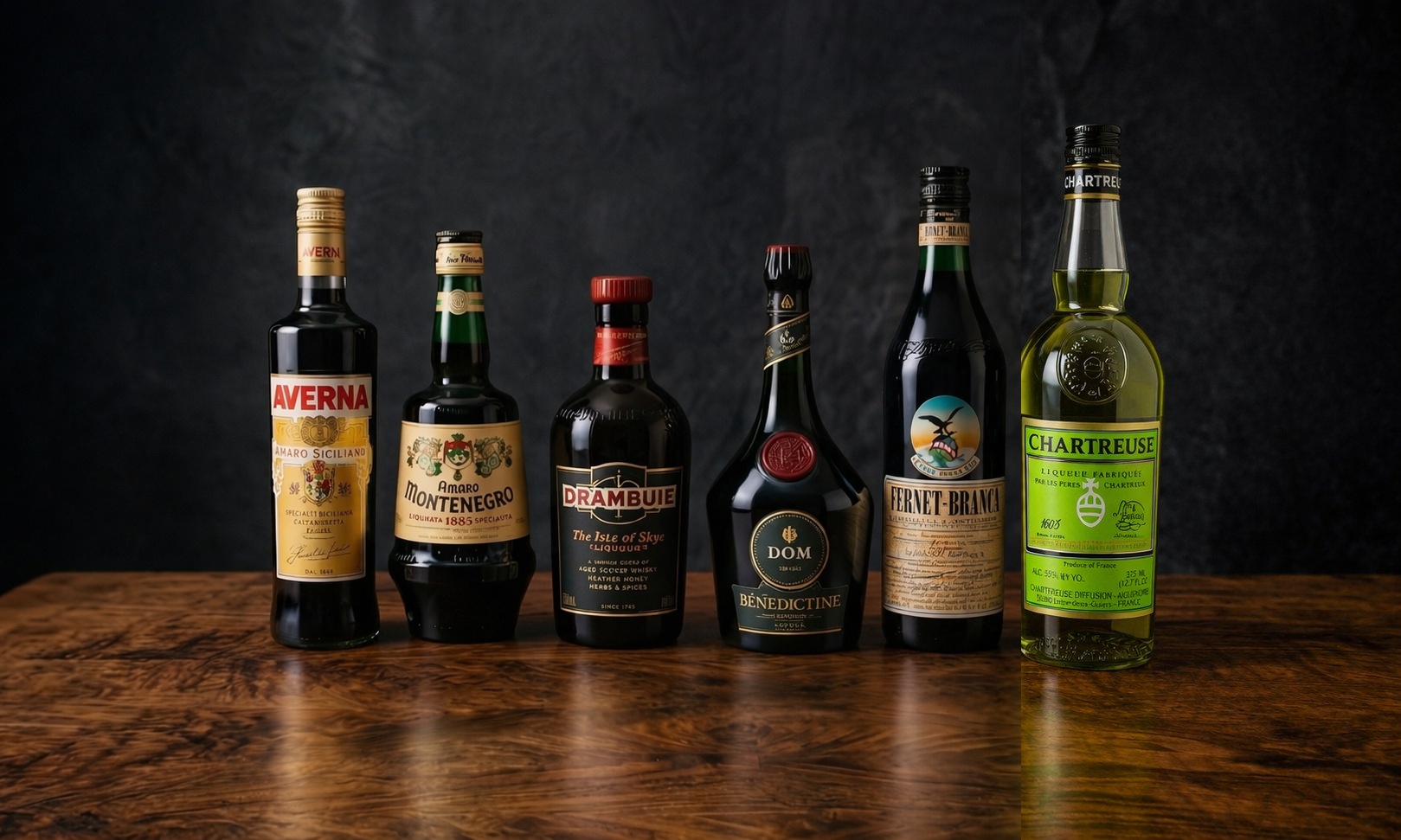
Six digestif bottles arranged on a dark walnut surface with glassware, photographed at the SSS digestif evening

We hosted an evening of digestifs for a small group. Six bottles, poured in order from light to heavy. The rule is simple: start light, save the difficult stuff for last. Same logic as a whisky tasting or a wine flight. The order is part of the drink.

Both evenings were produced by the Society of Scents and Spirits under The Society Table, our curated tasting experience for private dinners and corporate events. The spirit selection, serving order, cocktail pairings, and tasting cards were all designed in-house. If you want to bring something like this to your table, reach out at sales@societyofscentsandspirits.com.

↑ Back to top

2. The Six Bottles

The evening ran in this order: Averna, Amaro Montenegro, Drambuie, Bénédictine, Fernet-Branca, Chartreuse Verte.

Dram 1 · The Gateway
Averna
Sicily, 1868 · Rich, caramel and citrus

Sicily, 1868. Herbs, roots, and citrus peel steeped in spirit, sweetened and coloured with caramel. The gateway. Sweet enough to be easy, bitter enough to be honest.

Dram 2 · The Bartender’s Secret Weapon
Amaro Montenegro
Italy · Floral, bittersweet, approachable

Created in 1885 by Stanislao Cobianchi as Elisir Lungavita, then renamed in 1896 for Princess Elena of Montenegro, who married Victor Emmanuel, Prince of Naples and later King Victor Emmanuel III, that October. Around 40 botanicals: vanilla, orange peel, eucalyptus. Lighter and more floral than most amari. Bartenders reach for it because it cooperates. Most bottles in this category don’t.

Dram 3 · The Scottish Legend
Drambuie
Scotland · Scotch-based, heather honey and herbs

Aged Scotch whisky, heather honey, herbs, spices. Legend says Bonnie Prince Charlie gave the recipe to a MacKinnon clan member in 1746 after they sheltered him following Culloden, though historians treat that as a story built to sell bottles. What is documented is the Ross family of the Broadford Hotel on Skye working the recipe up commercially and registering the Drambuie trademark in 1893, with the MacKinnons taking over production about fifteen years later. Rich, warming, and drinkable.
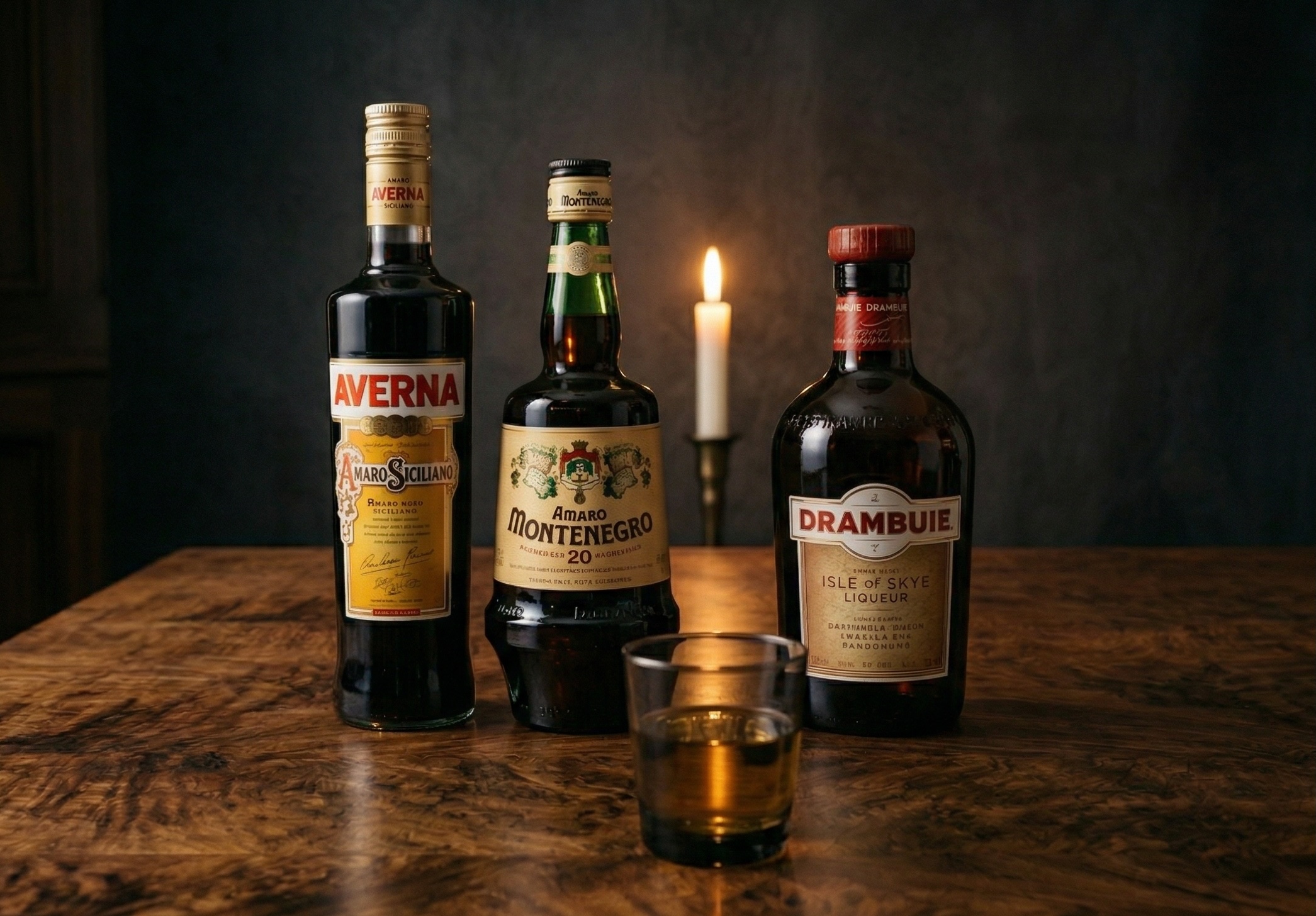
Averna, Amaro Montenegro and Drambuie lined up on a dark surface with candlelight
Dram 4 · The Monastic Masterpiece
Bénédictine
Normandy, France · 1510 · Honeyed, herbal, refined

The label starts the story in 1510 at the Benedictine Abbey of Fécamp in Normandy, with a monk’s elixir of 27 plants and spices recreated by Alexandre Le Grand in 1863. Most historians read that monastic pedigree as marketing for a liqueur Le Grand had just created himself. Every bottle reads D.O.M.: Deo Optimo Maximo. Nothing simple in this glass.

Dram 5 · The Industry’s Drink
Fernet-Branca
Milan, 1845 · Intense, minty, medicinal

Twenty-seven herbs, roots, and spices which the house says come from five continents. Branca dates it to Milan in 1845, to Bernardino Branca, and says the formula has not changed since; it lives in a safe only the company chairman can open, handed down father to son. A year in oak before it goes anywhere near a bottle. Ask a bartender what they drink after their shift. Usually this. The Ferrari cocktail in Part 1 is built on exactly this tension.

Dram 6 · The Finale
Chartreuse Verte
French Alps, 1840 · Complex, herbal, 110 proof

Carthusian monks, French Alps. The manuscript reached the Grande Chartreuse in 1737 and was set out in full in 1764; the green liqueur in this glass was named and released in 1840. 130 botanicals, and by the order’s own account the formula is held by two people at a time, though other accounts say three. One of the few liqueurs said to keep developing in the bottle after it’s sealed, though that claim is contested. The monks capped output at 1.6 million bottles a year, and the shortage that followed has turned older bottles into collector’s items. 110 proof. Serve it cold. Pour it small.

↑ Back to top

3. The Cocktails

Four cocktails after the flight, each showing a different side of the evening’s bottles.

Cocktail 1 · Whisky-Based
The Rusty Nail
2 oz Famous Grouse · 1 oz Drambuie
Build over ice · stir gently · lemon twist

Usually credited to the bartenders at New York’s 21 Club in the early 1960s, though the same two-ingredient build was printed as the B.I.F. back in 1937; the Rusty Nail name only stuck in 1963. Drambuie softens the Scotch and pulls out the honey. That’s the whole idea.

Cocktail 2 · Gin-Based
The Green Devil
1½ oz Beefeater · ¾ oz Green Chartreuse · ¾ oz fresh lime juice · ½ oz simple syrup
Shake · strain into coupe

Chartreuse and gin is one of the more underrated combinations. Both herbal, both opinionated. The lime stops it from becoming too much. A small pour of Chartreuse is enough to complement the gin.

Cocktail 3 · Vodka-Based
The Black Monk
1½ oz Absolut · ¾ oz Bénédictine · ½ oz fresh lemon juice · ¼ oz maple syrup
Shake · strain into coupe · lemon twist

Named for the D.O.M. monks. Bénédictine on a clean vodka base, framed by lemon and maple syrup. Tastes more put-together than it has any right to.

Cocktail 4 · The Bartender’s Handshake
The Ferrari
1 oz Fernet-Branca · 1 oz Campari · pinch of sea salt
Stir over ice · strain into small glass · pinch of sea salt

Equal parts Fernet-Branca and Campari. Nobody knows who made it first. The name is the color. Campari pulls the menthol edge off the Fernet. Fernet cuts Campari’s bitterness. Salt sharpens both. Order this without being prompted. The bartender will notice.


Part 2


4. Why Whisky Is the World’s Most Storied Spirit

The second event was at the Amateur Comedy Club in Murray Hill, founded in 1884 and, by its own account, the oldest continuously performing theatre group in America. Seven whiskies, seven regions, a cocktail for each. And at the end, something I’ve been working on for a while.

Seven whisky glasses lined up on a wooden table at the Amateur Comedy Club

No other spirit carries place the way whisky does. The peat in the bog, the grain in the field, the wood from a barrel that used to hold sherry. We went new world to old, easy to demanding. Buffalo Trace first. Laphroaig last.

↑ Back to top

5. The Seven Whiskies

Dram 1 · USA · Bourbon
Buffalo Trace
45% ABV · Vanilla, caramel, oak

Reportedly the oldest continuously operating distillery in America, though rivals dispute the title. Frankfort, Kentucky. Leestown was settled on the site in 1775 and accounts of distilling there run from that year, though the distillery’s own history dates whiskey stored on site to 1811 and a distillery proper to 1858. Buffalo Trace goes first because it argues with nobody. Vanilla, caramel, clean oak. Sets the reference point.

Dram 2 · Ireland · Single Pot Still
Redbreast 12
40% ABV · Orchard fruit, toasted wood, cream

Single pot still is Ireland’s own style. Malted and unmalted barley in the same mash. The unmalted barley gives it texture and spice you won’t find in Scotch. Bourbon and Oloroso sherry casks. A few people at the table said they didn’t drink Irish whiskey. They have since reconsidered their opinions.

Dram 3 · India · Single Malt
Paul John Brilliance
46% ABV · Tropical fruit, honey, light spice

Goa, foot of the Western Ghats. Six-row barley from the Himalayan foothills, and a tropical climate that compresses maturation: the heat drives the spirit into the wood faster, and the angel’s share runs 8 to 10 percent a year against 2 to 3 in Scotland. Unpeated flagship. Tropical fruit, honey, light spice. India is producing some of the most interesting whisky in the world right now and Paul John is one of the reasons people started paying attention.
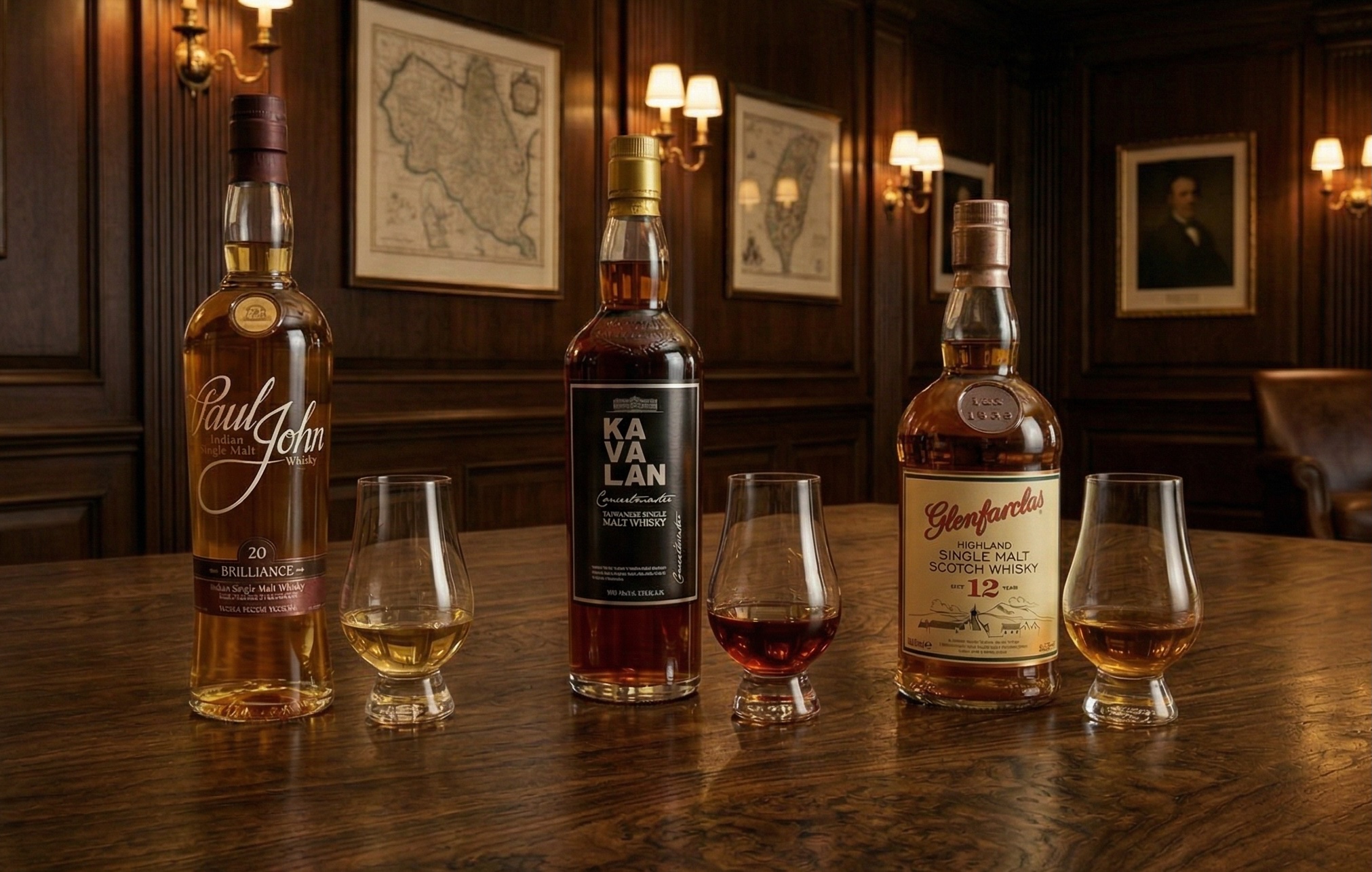
Paul John Brilliance, Kavalan Concertmaster and Glenfarclas 12 at the tasting
Dram 4 · Taiwan · Single Malt
Kavalan Concertmaster
40% ABV · Port cask · Red berries, chocolate, tropical fruit

Yilan Valley, Taiwan, founded 2005. Awards came fast: in a 2010 blind tasting held in Leith one of its whiskies beat three Scotches and an English malt, and its Vinho Barrique took World’s Best Single Malt at the 2015 World Whiskies Awards. Concertmaster finished in Port casks. Red berries, dark chocolate, tropical fruit. The room agreed on this one.

Dram 5 · Scotland · Speyside Single Malt
Glenfarclas 12
43% ABV · Sherry-forward · Dried fruit, toffee, gentle smoke

Grant family, Speyside, 1865. One of the last independent distilleries in the region. They mature in ex-Oloroso sherry casks rather than the ex-bourbon wood most distilleries lean on. That’s expensive. Glenfarclas doesn’t cut that corner. Dried fruit, toffee, a hint of smoke. I’ve watched people who said they don’t like whisky finish this glass and ask what it was.

Dram 6 · Japan · Blended Whisky
Nikka From The Barrel
51.4% ABV · Spice, oak, dark chocolate

Malt and grain married, put back into cask, bottled at 51.4%. Masataka Taketsuru trained in Scotland from 1918 to 1920, brought everything back to Japan. He thought whisky should be drunk at full strength. At 51.4%, it can take the ice or the dilution, and still show you what it is.

Dram 7 · Scotland · Islay Single Malt · The Finale
Laphroaig 10
43% ABV · Heavy peat smoke, iodine

Islay, 1815. The peat bogs the barley is dried over have been forming since the glaciers retreated, at roughly a millimetre a year. Laphroaig has held a Royal Warrant since 1994, granted in person at the distillery back when King Charles III was still Prince of Wales, which makes him the world’s most prominent fan of something that smells like a hospital on a beach. You will either love this or you won’t. No middle ground. Both reactions are correct.

↑ Back to top

6. The Cocktails & The Kannan

Cocktail 1 · Buffalo Trace
The Old Fashioned
2 oz Buffalo Trace · 1 sugar cube · 2 dashes Angostura bitters · splash of water
Stir over ice · rocks glass · orange twist

The 1806 definition of the word cocktail — spirit, sugar, water, bitters — is this drink. The name Old Fashioned only reaches print in 1880, when drinkers started asking for it the old-fashioned way. Buffalo Trace handles it cleanly.

Cocktail 2 · Redbreast 12
The Irish Mule
1½ oz Redbreast 12 · 4 oz ginger beer · ½ oz fresh lime juice
Build over ice in copper mug · lime wheel

Ginger beer leans into the spice in Redbreast. Lime echoes the fruit. Hand this to someone who says they don’t drink whisky.

Cocktail 3 · Paul John Brilliance
The Bombay Sour
1½ oz Paul John Brilliance · ¾ oz fresh lemon juice · ½ oz maple syrup
Shake · strain into coupe · lemon twist

Maple syrup instead of simple syrup because the raw depth fits the terroir. Paul John’s tropical fruit makes the sour format sing. Named for the city.

Cocktail 4 · Kavalan Concertmaster
The Taipei Sunset
1½ oz Kavalan Concertmaster · ½ oz Cointreau · ¾ oz fresh orange juice · ½ oz fresh lemon juice
Shake · strain into coupe · orange twist

Port cask, Cointreau, and orange juice are all on the same frequency. The lemon keeps it honest. Named for the Taipei mountain sunsets, which are worth seeing.

Cocktail 5 · Glenfarclas 12
The Rob Roy
2 oz Glenfarclas 12 · 1 oz sweet vermouth · 2 dashes Angostura bitters
Stir over ice · strain into coupe · cherry

The Manhattan’s Scottish cousin. Named after the Scottish folk hero Rob Roy MacGregor, most likely by way of the 1894 Broadway operetta about him, with the drink credited to the Waldorf-Astoria nearby; Difford’s notes competing accounts. We use Carpano Antica Formula for the sweet vermouth, which has enough body and spice to hold its own against the sherry in Glenfarclas. Stirred, served up.

Worth knowing: a Dry Rob Roy uses dry vermouth instead of sweet. A Perfect Rob Roy splits both equally. A Bobby Burns adds a dash of Bénédictine, which given the evening’s earlier pours was a natural encore.

Cocktail 6 · Nikka From The Barrel
The Tokyo Highball
2 oz Nikka From The Barrel · 4 oz sparkling water · optional: 2 drops yuzu juice
Build over large ice in highball glass · lemon twist

The Japanese highball is its own discipline. Ice size, glass temperature, water ratio. Nikka at 51.4% handles the dilution without disappearing. The yuzu is optional.
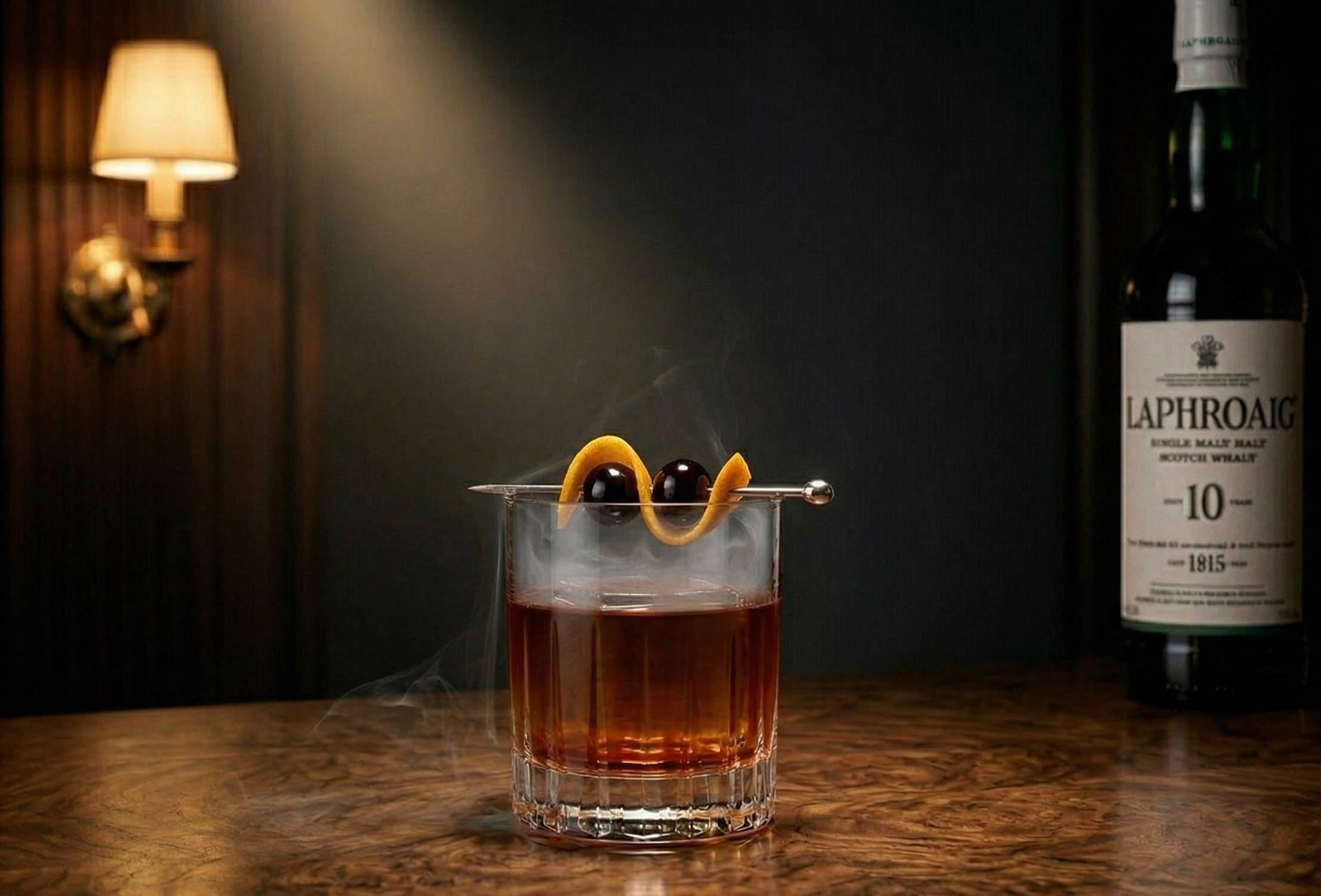
The Kannan cocktail with two Angostura cherries and visible smoke at the Amateur Comedy Club
Cocktail 7 · Laphroaig 10 · The Signature
The Kannan
Demerara sugar crushed with a teaspoon of club soda · 2 oz Buffalo Trace bourbon · splash of Laphroaig 10
Smoked with apple cherry wood · two Angostura cherries
Muddle sugar and soda · add bourbon · stir over ice · add Laphroaig · smoke the glass · garnish

Old Fashioned bones, taken further. Demerara sugar for the molasses depth. Buffalo Trace as the base. A splash of Laphroaig for peat and smoke, just enough to shift the character without taking over. Apple cherry wood smoke pulls it together. Two Angostura cherries.

I’ve been working on this for a while. The Amateur Comedy Club is where it finally felt done.

Bring This to Your Table

Both evenings were produced under The Society Table, the SSS curated tasting experience. We select the spirits, design the serving order, build the cocktail pairings, and produce the printed cards. The format is flexible. A curated lineup you run yourself, or a fully hosted evening with presentation. Private dinners and corporate events both welcome. More events coming. Watch the Journal and social channels.

Get in touch at sales@societyofscentsandspirits.com.


Subscribe

Sources

  1. Averna dating itself to 1868 is the brand’s own claim, carried on its site as l’autentico amaro che incanta dal 1868: Amaro Averna, whose history pages were offline for maintenance when this was checked. The herbs, roots, spices and bitter orange and lemon peel, and the caramel: Wikipedia, used here as a cross-check because no primary was reachable. No source consulted lists honey in Averna, so the line now says caramel only.
  2. Amaro Montenegro created in 1885 by Stanislao Cobianchi as Elisir Lungavita and renamed in 1896 for Princess Elena of Montenegro, with roughly 40 botanicals including vanilla, orange peel and eucalyptus: Wikipedia, again as a cross-check; the brand’s own site is age-gated and states only “since 1885” and 23% alc/vol, and does not publish a botanical count. This page previously said “over 40” and listed coriander; no source supports either.
  3. Elena of Montenegro married Victor Emmanuel, Prince of Naples, in October 1896, four years before he became King Victor Emmanuel III on 29 July 1900: Wikipedia. He was heir apparent, not yet king, at the time of the marriage.
  4. Drambuie as a blend of aged Scotch whisky, heather honey and aromatic herbs and spices: Drambuie’s own site, which does not itself make any dating claim for the recipe.
  5. The Bonnie Prince Charlie legend, the 1746 gift to Captain John MacKinnon after Culloden, and historians’ view that it was concocted to boost sales: Wikipedia. The documented commercial line — the recipe passing to John Ross of the Broadford Hotel on Skye around 1872, his son James Ross registering the Drambuie trademark in 1893, and Calum MacKinnon taking over production in Edinburgh around 1908 — is from Difford’s Guide. The two disagree on the start of commercial production: Difford’s says 1908, Wikipedia says 1910, and “about fifteen years later” above is compatible with either. This page’s earlier claim that Drambuie is “300 years old” has no support in either and has been cut.
  6. Bénédictine’s own account: an elixir the Benedictine monk Dom Bernardo Vincelli “is said to have created” in 1510 at the abbey of Fécamp, and Alexandre Le Grand recreating it in 1863: Bénédictine, Heritage. The count of twenty-seven plants and spices is also the brand’s own: benedictinedom.com. Note that the brand’s version has the manuscript handed down rather than lost in the Revolution and found again, which is how this page previously had it.
  7. The reading of the 1510 monastic origin as a marketing invention by Le Grand: Wikipedia, which states flatly that Le Grand developed the recipe in 1863 with a chemist’s help and embellished a monastic backstory. Tasting Table is softer, calling it a story that “can be taken verbatim or passed off as a brilliant marketing strategy.” The two are not equivalent: one calls it invented, the other calls it unproven.
  8. D.O.M. standing for Deo Optimo Maximo: Wikipedia.
  9. Fernet-Branca’s 27 herbs, roots and spices, the statement that they “come from five continents,” and the mixture resting in oak barrels for a year: Branca Distillerie, the producer’s own product page. This page previously said four continents; Branca says five, so the sentence now follows Branca and names it as the house’s claim.
  10. The 1845 date and Bernardino Branca, and the formula kept “in a safe that can only be accessed by the company’s chairman, and which continues to be bequeathed from father to son”: Fernet-Branca’s own history, and the brand homepage for the 27-herb figure. This is the house’s account of its own recipe, not independent confirmation, and the text above now says so rather than claiming only the family knows the list.
  11. Chartreuse’s timeline as the order tells it: the manuscript reaching the Grande Chartreuse in 1737 under prior Dom Michel Brunier de Larnarge, set out in a seven-page manuscript titled Composition of the Elixir of Chartreuse in 1764, and the two liqueurs formally named Green and Yellow Chartreuse by Father Garnier in 1840: Chartreuse, official history. The brand’s product page dates the green liqueur itself to 1840: Chartreuse Verte. Wikipedia tells it differently, crediting Brother Gérome Maubec with the 1737 work and dating 1764 to the Elíxir Végétal rather than to the liqueur, but agrees on 1840 for Green Chartreuse. This page previously dated the green liqueur to 1737.
  12. The 130 plants, flowers, barks, roots and spices, and the claim that only two people know the formula: Chartreuse and its history page. Wikipedia says three monks. They disagree, and the text above now says so rather than asserting two.
  13. Green Chartreuse at 55% ABV, which is the 110 proof quoted above: Chartreuse, confirmed by Wikipedia.
  14. The claim that Chartreuse keeps improving in the bottle is contested. The producer says only that after ageing in oak the liqueur “continue d’y développer sa complexité”: Chartreuse. Wikipedia carries the line that it is “one of a handful of liqueurs that continue to age and improve in the bottle” but flags it as dubious. Nothing supports the “one of only two spirits” version this page used to carry, which has been cut.
  15. The Carthusians’ decision to hold production at 1.6 million bottles a year, taken in 2019 and cited to the environmental cost of production and the monks’ wish to return to solitude and prayer, and the worldwide shortages that followed: Wikipedia, used here because the order’s own site does not publish the figure.
  16. The Rusty Nail’s history: first printed in 1937 as the B.I.F., credited to F. Benniman; David Wondrich on the drink cycling through names for a generation; Dale DeGroff’s attribution to the bartenders of the 21 Club in the early 1960s; and the name settling in 1963 when Gina MacKinnon of the Drambuie Liqueur Company endorsed it in The New York Times: Wikipedia. The 1937 printing and the 21 Club attribution are in direct tension; the text above now carries both.
  17. The Amateur Comedy Club’s 1884 founding, its clubhouse in Sniffen Court at 150 East 36th Street, and its claim to be the oldest continuously performing theatre group in America: the club’s own history page and its home page. That ranking is the club’s own framing, not an independently audited one, and the club is a theatre group rather than a private members club, which is how this page previously had it.
  18. Buffalo Trace at 45% ABV, 90 proof, with vanilla, brown sugar, toffee and dark fruit: the distillery’s own brand page. This page previously gave it as 40%. The Leestown site at Frankfort, established by Hancock and Willis Lee in 1775, whiskey stored in a stone warehouse on the Kentucky River from 1811, and a formal distillery from 1858: Buffalo Trace’s history page. The “in production since 1787” date this page used to carry appears in neither source and has been cut.
  19. The two sources disagree on when distilling started on the site. Wikipedia dates distilling to 1775 with the Lee brothers and the first distillery building to 1812 under Harrison Blanton; the distillery’s own history starts the whiskey record at 1811 and the distillery at 1858. The text above now carries both. Wikipedia is also the source for the disputed nature of the “oldest continuously operating distillery in America” claim.
  20. The rival title: the Guinness World Record for oldest operating bourbon distillery belongs to Maker’s Mark in Loretto, Kentucky, distilling since 1805, recognised on 3 April 2001. Buffalo Trace’s claim is the company’s own and is contested.
  21. Ireland’s single pot still style, as legally defined: a mash of a minimum 30% malted barley and a minimum 30% unmalted barley, with up to 5% other cereals, matured at least three years in wooden casks not exceeding 700 litres and bottled at a minimum 40% ABV. Read from the Irish Whiskey Technical File, the document filed with the European Commission in 2014, hosted by Drinks Ireland.
  22. Redbreast 12 at 40% ABV, made from malted and unmalted barley and matured in a combination of bourbon and sherry casks: Redbreast’s own product page, which does not itself specify Oloroso. The Oloroso specification quoted above comes from Wikipedia and Tasting Table, which agree on it; no primary Gilbey document is reachable.
  23. Paul John Brilliance at 46% ABV, unpeated, matured in American bourbon casks and distilled in Goa: Paul John’s own product page. The six-row barley and the maturation figures — an angel’s share of 8 to 10% a year in coastal Goa against 2 to 3% in Scotland, and barley sourced from Rajasthan, Punjab, Haryana and Uttarakhand through to the Himalayan foothills: Paul John on Indian six-row barley. The “five years does what Scotland takes twelve to do” ratio this page used to carry is a rule of thumb no source supports, and has been replaced with the distillery’s own figures.
  24. Kavalan founded in 2005 in Yilan, Taiwan: Kavalan’s own site. The 2010 blind tasting in Leith where a Kavalan beat three Scotch whiskies and an English one, and Vinho Barrique taking World’s Best Single Malt at the 2015 World Whiskies Awards: Wikipedia. This page previously claimed Kavalan had won more awards than almost any distillery its age; no source supports the superlative, so the two documented results replace it.
  25. Kavalan Concertmaster at 40% ABV, matured in American oak and finished in Ruby, Tawny and Vintage Port casks: no distillery product page for Concertmaster was reachable in this pass, so the specification is taken from the retailer Master of Malt.
  26. The legal definitions behind the dram labels above. Single Malt Scotch Whisky is distilled at a single distillery from water and malted barley only, in pot stills; Blended Scotch Whisky is a blend of one or more single malts with one or more single grains; the spirit must be matured in Scotland in oak casks not exceeding 700 litres for at least three years and bottled at not less than 40% ABV: Scotch Whisky Regulations 2009, regulation 3.
  27. Islay and Campbeltown are protected localities; Highland, Lowland and Speyside are protected regions. The regulations draw that distinction and it is not decorative: Scotch Whisky Regulations 2009, regulation 10.
  28. John Grant bought Glenfarclas on 8 June 1865, the family has held it through six generations, and the whisky is routinely matured in ex-sherry casks: scotchwhisky.com’s Whiskypedia entry on J&G Grant. Glenfarclas 12 at 43% ABV with Oloroso sherry maturation: Master of Malt; glenfarclas.com blocks automated fetching. No source supports the earlier claim that Glenfarclas ages entirely in first-fill Oloroso casks, and that has been softened above.
  29. Nikka From The Barrel at 51.4% ABV, a blend of over a hundred malt and grain whiskies drawn primarily from Nikka’s two Japanese malt distilleries and its Coffey grain whiskies, returned to cask for a few months to marry: Nikka’s own product page. It is a blended whisky, not a blended malt, and the dram label has been corrected. Nikka does not state a chill-filtration policy for it on any page reachable here, so that claim has been cut rather than hedged.
  30. Masataka Taketsuru arrived in Scotland in December 1918, studied at the University of Glasgow, apprenticed at Longmorn, Bo’ness and Hazelburn, and returned to Japan in November 1920: Wikipedia. This page previously placed his training in “the 1910s”, which only just holds.
  31. On the Japanese category itself: the labelling standard adopted by the Japan Spirits and Liqueurs Makers Association in 2021 requires fermentation, distillation, maturation and bottling in Japan using Japanese water, its grace period ended in 2024, and it is a voluntary trade standard rather than law. Wikipedia; the association’s own posting of the standard was not reachable in this pass.
  32. Laphroaig established in 1815 by Donald and Alexander Johnston, and the 10 Year Old bottled at 40% or 43% depending on market: Wikipedia. Its Royal Warrant, granted in 1994 to the then Prince of Wales and now held from HM The King: the Royal Warrant Holders Association directory. Laphroaig’s own heritage page dates the visit and the warrant to the same 1994 occasion: “In 1994, HRH Prince Charles visited Laphroaig for the first time and gave us his Royal Warrant,” Laphroaig. The warrant was granted to a Prince of Wales, not to a sitting monarch.
  33. Peat age: most high-latitude peat bogs formed after the glaciers retreated at the end of the last ice age, around 12,000 years ago, accumulating at roughly a millimetre a year: Wikipedia’s peat entry, used here as a cross-check because no Islay-specific dating was reachable. The “10,000-year-old Islay bogs” figure this page used to carry could not be verified and has been replaced with the general formation account.
  34. The 1806 definition of “cocktail” as spirits, sugar, water and bitters appeared in The Balance and Columbian Repository on 13 May 1806. The phrase “old-fashioned cocktails” reaches print in the Chicago Daily Tribune in February 1880, and the earliest recipe under that name is in Theodore Proulx’s 1888 Chicago manual. The Old Fashioned is a revival of the earlier style rather than the oldest surviving cocktail recipe, which is how this page previously had it: Wikipedia.
  35. The Rob Roy and the 1894 operetta: the drink is usually tied to the Broadway operetta about Robert Roy MacGregor and to the Waldorf-Astoria nearby, but the account is contested. Edward F. Barry described a different Rob Roy in an 1873 New York Sun interview, the first recognisably modern recipe appears in James C. Maloney’s 1900 guide, and David Wondrich found a 1941 letter crediting the New Jersey bartender Henry August Orphal. Difford’s Guide carries all of these and does not settle between them.
  36. The serving order, the tasting impressions, the evening’s programme, the Green Devil, the Black Monk, the seven whisky-night cocktail builds and The Kannan are the Society’s own work and need no citation. The Ferrari’s equal-parts Fernet-Branca and Campari build is bar folklore with no documented originator, and the text above says as much rather than assigning one.
← Previous Post Back to Journal Next Post →
Subscribe