Key Takeaways
- Thermal breakdown of plant material is the shared mechanism behind a braai, peated whisky, cigar smoke, and smoky perfumery, producing overlapping families of phenolic compounds including guaiacol, syringol, cresols, and catechols.
- Guaiacol and syringol are both genuinely smoky and aroma-active on their own, not a clean taste-versus-smell split, and hardwood lignin (like camelthorn's) carries more syringyl-derived compounds than softwood lignin does, which is part of why a hardwood braai smells different from a softwood campfire.
- The same guaiacol-led family of phenols shows up in peat-kilned malt (Ardbeg is peated to a minimum of 55 PPM; other Islay distilleries' figures vary by source and batch), cigar tobacco pyrolysis, and cade oil and birch tar in perfumery; those PPM figures describe the malt, not the finished whisky, since most phenols are lost through distillation and maturation.
Heritage Day was September 24 in South Africa, which is when this piece was supposed to go up. Since 2005, a parallel National Braai Day campaign started by Jan Scannell has encouraged South Africans to mark Heritage Day around a fire. He left a career in financial services to spend a year promoting it, drove a forty-day tour of heritage sites braaiing along the way, and set a world record in 2010 for the longest continuous braai, 28.5 hours. In 2007, Archbishop Desmond Tutu became its patron, calling a braai one of the few things genuinely shared across South Africa's regions and communities. The pitch was simple: pick something everyone already does around a fire, and let that be the common ground.
A braai is not a cookout with a different accent. The wood matters. Kameeldoring, camelthorn in English, is one prized option, particularly where it's available, valued for dense, long-lasting coals and a distinctive wood smoke, though depending on geography, braaiers reach just as often for rooikrans, sekelbos, mopane, or black wattle. And the method matters more than the wood: coals arranged into zones, direct heat for what needs to cook fast, indirect for what needs time, embers preferred over open flame because flame chars unevenly. The South African description of the whole thing comes down to one word: patience. You respect the fire.
I don't braai. But I own a shelf of things that got their character the same way a braai does, by sitting downwind of burning plant matter and absorbing what came off it. A peated Islay whisky. A cigar. A handful of fragrances built around cade oil or birch tar. All four, the braai included, run on the same underlying chemistry: thermal breakdown of plant material, lignin chief among the sources, throwing off a family of phenolic compounds. What differs is the plant, the temperature, and how long the smoke sits in contact with what it's flavoring. That's the whole difference between a glass of Ardbeg, a cigar, a bottle of Cuir de Russie, and dinner on a Tuesday.
What's Actually Burning
Thermal breakdown of plant material is the common mechanism behind all four, with lignin playing the lead role in the smoky phenols that wood and other lignified material give off. Heat plant matter without enough oxygen to let it fully combust, and lignin, the polymer that gives wood its rigidity, breaks apart into a cluster of phenols: guaiacol, syringol, the cresols, catechol, and a few others that keep showing up under different names depending on which industry is measuring them. This is documented, reproducible organic chemistry, not folklore, and it's why smoke from four completely different sources still smells like it's related.
Guaiacol, syringol, and their derivatives are the phenols that give wood smoke its smoky, woody, and sometimes medicinal character; sensory panels rate guaiacol itself as distinctly smoky and woody on its own, not just a taste compound. Hardwood smoke tends to carry more syringyl-derived compounds than softwood smoke, because hardwood lignin contains both guaiacyl and syringyl building blocks where conifer lignin runs mostly guaiacyl alone. That's part of why a hardwood braai smells different from a softwood campfire before you've even put meat on the grate.
Peat, Already Covered in Depth
I wrote the long version of this one already: Islay and Smoke breaks down how peat, partially decayed moss and heather compacted in a bog, gets burned under a malting kiln, and how the smoke passes through wet barley and leaves phenolic compounds behind that get measured afterward in parts per million. Ardbeg's malt is peated to a minimum of 55 PPM, by the distillery's own account. Laphroaig and Lagavulin are also heavily peated, though quoted malt-phenol figures vary by source and batch. Worth saying plainly: those PPM numbers describe the malt before distillation, not the whisky in your glass. Phenol levels fall throughout production, and the spirit cut matters greatly: many of the heavier smoky phenols arrive late in the run, so some make the new make while others remain in the feints. Maturation changes the profile again. Peat isn't wood, botanically, but it pyrolyzes the same way wood does, releasing the same guaiacol-led family of phenols, at concentrations a malting kiln is built to control precisely. A braai fire controls nothing. It's the same chemistry, running with the safety off.
Tobacco
A cigar runs a related thermal-decomposition process on tobacco rather than wood. Laboratory pyrolysis research on tobacco breaks the temperature range into two bands. Below roughly 350°C, the leaf itself decomposes directly into hydroquinone, catechol, guaiacol, and a couple of methylated catechols. Push past 350°C, up toward 600°C, and cresols start forming too, not from the leaf directly anymore but from the char left behind after the first wave of decomposition already happened. That work studied tobacco pyrolyzed in a lab, not a cigar actually burning, but a burning cigar has a steep temperature gradient of its own, hot at the coal, cooler back through unburned leaf, so real cigar smoke likely draws phenols formed under very different thermal conditions in a single pull. The exact ratio shifts by tobacco type. Bright and oriental leaf produce more hydroquinone and catechol than burley does, by a meaningful margin, according to the same research.
Perfumery
Perfumers get the same chemistry from wood on purpose, distilled instead of inhaled. Cade oil comes from prickly juniper, Juniperus oxycedrus, heartwood and roots sealed in a retort and heated to 400 to 600°C with the oxygen cut off. What comes out is a tar, rectified down for use; some analyses put its guaiacol content near 12 percent alongside cresols and creosol, though cade-oil composition varies substantially with source and processing. It smells like dense phenolic smoke, harsher and more medicinal than its closest cousin, with campfire ash and tanned hide underneath. Birch tar is the gentler relative, birch bark pyrolyzed at 400 to 500°C into a liquid built on guaiacol, the cresols, catechol, pyrogallol, and xylenol. It opens harsh, almost caustic, and softens over hours into a leathery warmth with a thread of burnt sugar. Birch tar is historically central to the Russian-leather idea behind Cuir de Russie; Chanel's current description still places birch wood at the heart of the composition. Cade occupies a related smoky, phenolic corner of the same perfumer's palette. Many current formulas recreate that smoky-leather effect with other materials rather than crude natural tars, since crude cade oil and crude birch tar are both barred from fragrance use outright; only rectified versions meeting strict limits on polycyclic aromatic hydrocarbons are allowed.
One Family of Molecules, Four Different Rooms
Guaiacol shows up in all four. So do close relatives of it. What changes is the source material and the temperature, and that's enough to make a peated Islay whisky, a cigar, a leather perfume, and a braai smell nothing alike despite running on overlapping chemistry. Peated Islay whisky can read medicinal, earthy, even briny, but that impression comes from the whole spirit working together, not one peat compound acting alone. Tobacco's sweetness comes from sugars and other cured-leaf compounds breaking down alongside those phenols, not simple caramelization. Cade oil's harshness comes from a higher pyrolysis temperature and a resinous wood. And camelthorn smoke, the actual subject of today, shares some of the same wood-derived phenolic chemistry as birch tar: both begin with hardwood material under heat, even though one comes from an open fire and the other from controlled pyrolysis.
What Actually Holds Up Next to a Braai
A braai's smoke is aggressive and it's happening in real time, which rules out anything that would get flattened by it. There are two ways to play it. Echo: a whisky with real peat character holds its own, something in the Ardbeg-to-Laphroaig range, meeting the braai's smoke directly rather than getting lost next to it. Contrast: something rich and sweet instead, a sherried whisky or a high-proof bourbon whose fruit and body read as its own thing rather than disappearing. Either can work; a robust unpeated dram isn't automatically the wrong call, it just needs enough weight to hold the room. A cigar wants the same logic. A full-bodied Nicaraguan works because it's built to stand up to its own smoke; a well-aged Dominican puro can go either way since Dominican cigars range enormously in strength, so match the specific cigar's body rather than the country. The goal isn't matching flavors exactly. It's matching intensity, so nothing in the pairing has to apologize for the other.
None of this needed to be complicated. A braai, a peated whisky, a cigar, and a bottle of Cuir de Russie are all, underneath everything else going on, doing the same basic thing to plant matter. Different plant. Different heat. Same family of molecules, in four very different mixtures.
Cheers.
Pull up a chair.
New writing on fragrance, spirits, and cigars goes up multiple times a week. Subscribe free on Substack for the Bite-Sized Brief, or pay a nominal fee to read the full article.

Sources
- National Braai Day's 2005 founding, Jan Scannell's role, and the 2010 28.5-hour braai record: Cape Town Magazine, "Jan Braai"
- Archbishop Desmond Tutu becoming Braai Day's patron in 2007, and Braai Day's status as an informal, parallel campaign layered onto the official Heritage Day holiday: South African History Online, "Heritage Day, Braai Day or Shaka Day: Whose Heritage is it Anyway?"
- Braai wood selection, direct vs. indirect fire zones, and the emphasis on embers over flame: BBQHost, "Guide To South African Braai: BBQ & Tradition"; kameeldoring's density, coal longevity, and smoke character specifically: Cape Town Firewood, "Kameeldoring"
- Peat's phenolic chemistry: previously sourced and detailed in this Journal's own Islay and Smoke
- Ardbeg's malt peating level (minimum 55 PPM): Ardbeg, "Whisky Making at Ardbeg". PPM describing the malt rather than the finished spirit, and how much distillation and maturation change the phenolic load: Master of Malt, "Why PPM Can Be Misleading"
- Guaiacol and syringol's actual sensory roles in wood smoke, and hardwood versus softwood lignin composition: "Sensory Characteristics of Various Concentrations of Phenolic Compounds Potentially Associated with Smoked Aroma in Foods," MDPI/Molecules
- Tobacco pyrolysis phenolic compound formation by temperature band, and variation by tobacco type (bright, oriental, burley): "Phenolic compound formation from the low temperature pyrolysis of tobacco," ScienceDirect
- Cade oil and birch tar production, composition, and scent profile: Première Peau, "Cade Oil in Perfumery" and "Birch Tar in Perfumery"
- IFRA's restriction of crude cade oil and crude birch tar (prohibited outright) versus rectified material meeting PAH limits (permitted): IFRA Standard 119, Cade Oil; IFRA Standard 114, Birch Wood Pyrolysate
- Chanel's current description of Cuir de Russie, centered on birch wood and labdanum: Chanel, "Cuir de Russie - Les Exclusifs de Chanel"
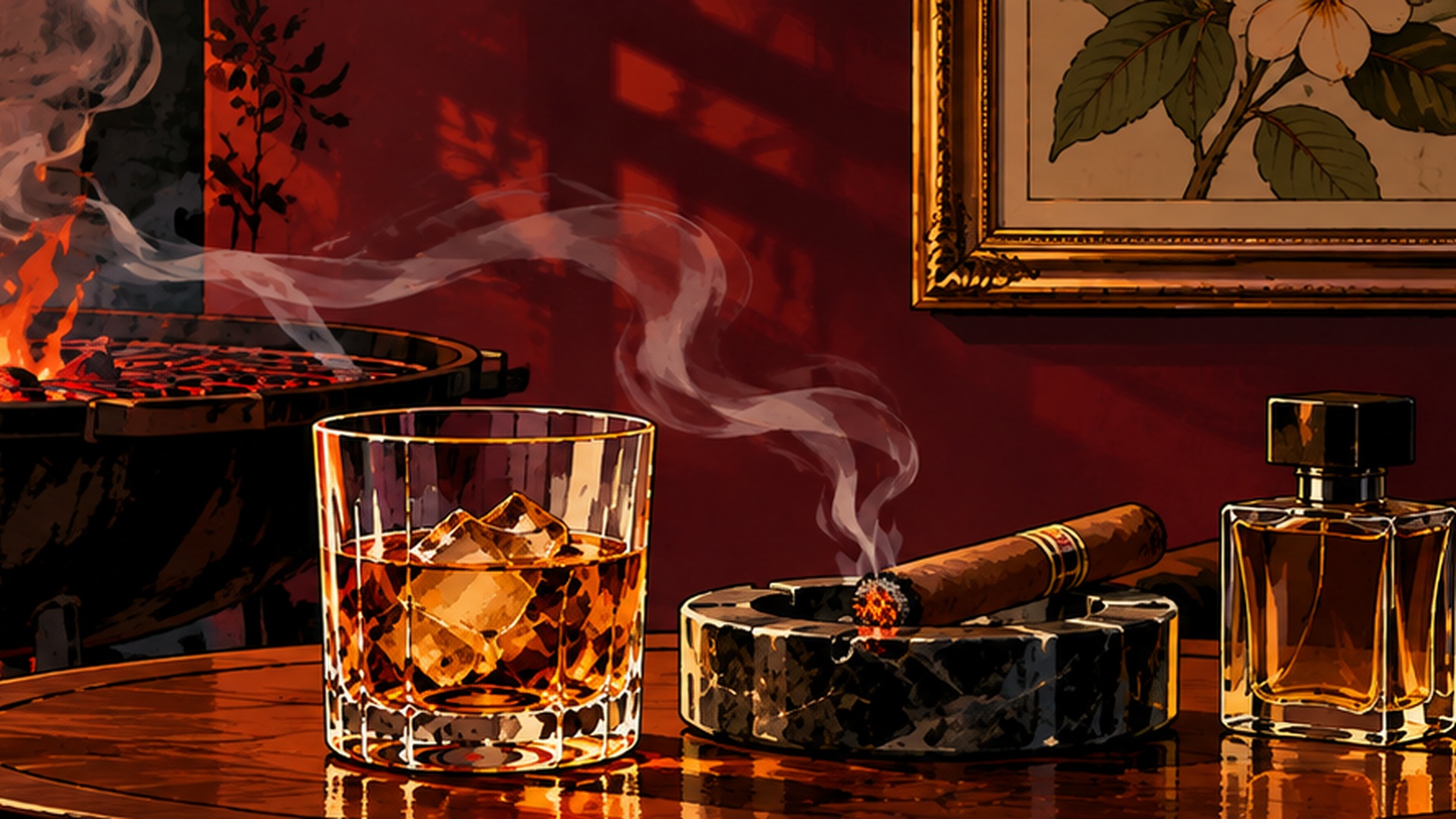
A note on the image in this piece: the hero illustration is AI-generated.