Most people who get into spirits eventually reach the same point. They have a decent home bar. They've tasted enough whisky and gin and rum to know what they like. But when someone asks them to make a drink, they default to the same two or three things they've always made.
That's fine. But there's a small handful of cocktails that every serious drinker should be able to make from memory. Not because they're complicated. Because they're foundational. Once you can build these, you understand how cocktails actually work, and you can riff on almost anything from there.

From left to right: Old Fashioned, Negroni, Martini, Daiquiri, Manhattan. The five drinks below are the foundation. Learn these and you can build almost anything else.
The Old Fashioned
The original cocktail. Sugar, bitters, water, spirit. That was the entire definition when the word "cocktail" first appeared in print in 1806. Everything else came later.
Build it in the glass. One sugar cube or a barspoon of demerara syrup. Three dashes of Angostura. A small splash of soda water to dissolve the sugar. Stir until it looks like syrup. Add two ounces of bourbon or rye. A large ice cube. Stir until cold and slightly diluted. Express an orange peel over the top, then drop it in. That's it.
The mistake most people make is adding too much fruit. The Old Fashioned is not a fruit salad. The orange peel is for aroma. If you're muddling cherries and orange slices, you're making something else, and that something else is usually worse.
The Negroni
Equal parts gin, Campari, and sweet vermouth. Stir over ice. Strain into a rocks glass with a large cube. Orange peel.
The Negroni was invented in Florence around 1919 when Count Camillo Negroni asked his bartender to strengthen his Americano by swapping the soda water for gin. It's the easiest impressive cocktail you can make. Three ingredients, no special technique, and the result is balanced, bitter, and grown up.
Use a London dry gin with backbone. Beefeater works. Tanqueray works. Skip the soft floral gins for this one, they get lost. For the vermouth, Carpano Antica Formula is the gold standard. It's richer and more complex than the standard Italian sweet vermouths and it takes the drink to another level. Once you've had a Negroni made with Carpano, the regular ones taste flat. (Carpano also drinks beautifully on its own as a digestif. More on that here.)
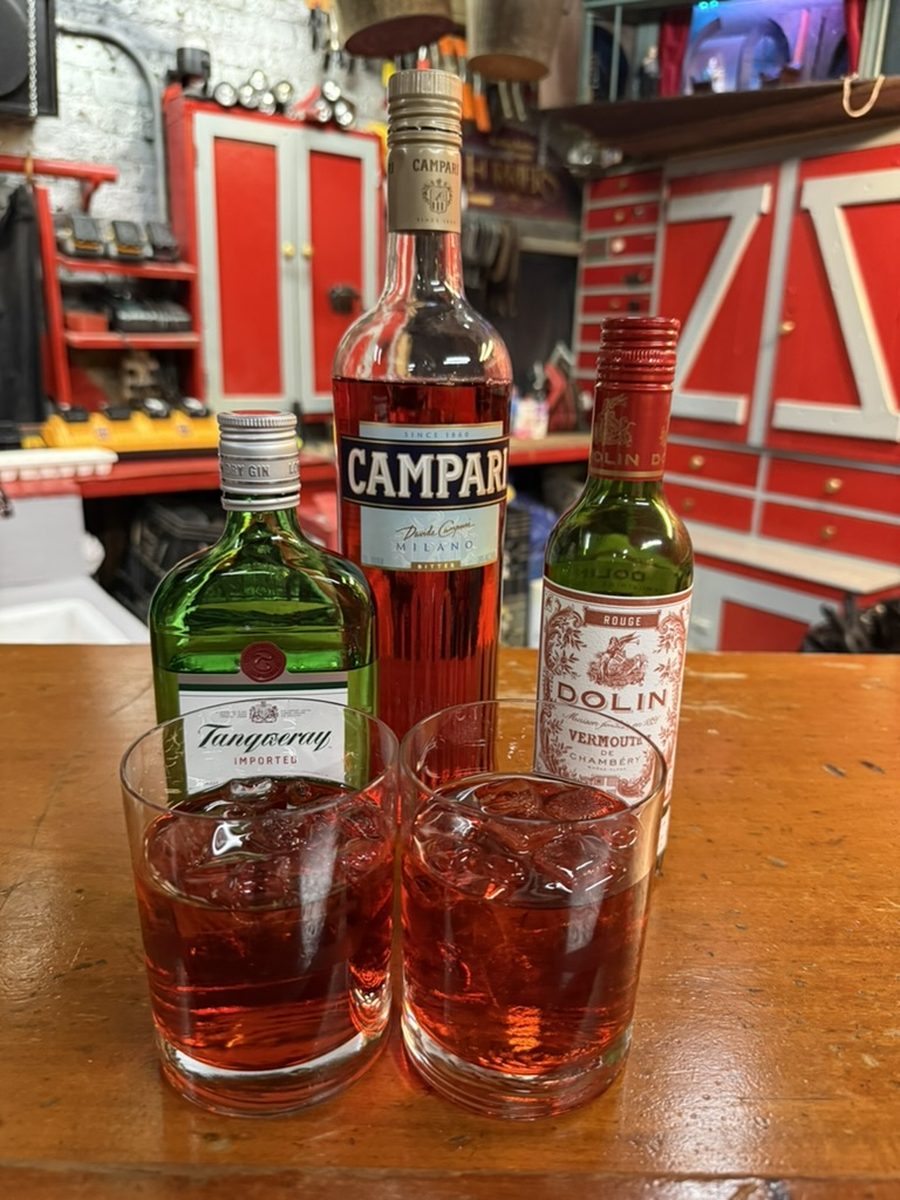
Negronis at the Amateur Comedy Club. A members' favorite, and for good reason. Three ingredients, equal parts, stirred over ice. The kind of drink that tastes like it belongs there.
The Martini
The most argued-about drink in the world. Vodka or gin. Stirred or shaken. Wet or dry. Olive or twist. Everyone has an opinion.
Here's a starting point. Two and a half ounces of gin. Half an ounce of dry vermouth. Stir over ice for about thirty seconds. Strain into a chilled coupe or martini glass. Lemon twist or a single olive.
The vermouth ratio is the only real variable. A 5:1 ratio like the above is balanced and modern. A 50:50 Martini is closer to what people drank a hundred years ago and is genuinely delicious if you've never tried it. The "barely whisper vermouth across the gin" approach gives you a glass of cold gin, which is fine, but it's not really a cocktail at that point.
Bond drank his shaken. He was wrong. Shaking aerates the drink and makes it cloudy. Stirring keeps it crystal clear and silky. Stir.
The Daiquiri
Forget the frozen slushy version. The original Daiquiri is one of the cleanest, most elegant drinks ever invented. Two ounces of white rum, three quarters of an ounce of fresh lime juice, half an ounce of simple syrup. Shake hard with ice for ten seconds. Strain into a chilled coupe.
Three rules. Fresh lime, never bottled. The lime is the entire drink. Bottled lime juice will ruin it. Use a real white rum with character. Plantation 3 Stars or Probitas both work beautifully. Cheap white rum gives you a thin, harsh result. And shake it cold. The dilution and chill matter as much as the ingredients.
If you want to understand how a great cocktail balances sweet, sour, and spirit, the Daiquiri is the textbook. Every other sour drink, the Margarita, the Whiskey Sour, the Sidecar, follows the same pattern.
The Manhattan
Two ounces of rye whiskey. One ounce of sweet vermouth. Two dashes of Angostura. Stir over ice. Strain into a chilled coupe. Brandied cherry.
Use rye, not bourbon. Bourbon Manhattans exist and they're fine, but the dryness and spice of rye is what makes the drink sing against the sweetness of the vermouth. Rittenhouse Bonded is the classic choice and costs almost nothing. Sazerac 6 Year is another excellent option.
Again, Carpano Antica Formula in the vermouth slot will transform this drink. So will Cocchi Vermouth di Torino. Skip the dusty bottle of Martini Rosso that's been open in your fridge for two years. Vermouth is fortified wine. It oxidizes. Buy small bottles, store them in the fridge, replace them every two months.
Building From Here
These five drinks teach you the four cocktail templates that almost everything else is built from. Spirit-forward stirred (Old Fashioned, Manhattan, Martini, Negroni). Sour shaken (Daiquiri). Once you know how to balance those, you can riff endlessly. A Boulevardier is a Manhattan with Campari swapped for the bitters. A Vesper is a Martini with vodka added. A Whiskey Sour is a Daiquiri with whiskey, lemon, and a touch of egg white.
The other thing learning the classics gives you is the ability to put your own twist on one. This is where you actually become memorable as a host. Anyone can pour a Negroni. The person who hands you a Negroni with a split base of gin and mezcal, or one built on Suze instead of Campari, is the person you remember.
Hemingway is the textbook case. He walked into El Floridita in Havana, tasted their house Daiquiri, and asked for it without sugar and with double rum. That one request became the Papa Doble. The bar added maraschino and grapefruit juice later, and now every serious bar in the world knows what a Hemingway Daiquiri is. One man's tweak to a classic became a drink people order a century later.
You don't need a century. You just need one well-chosen variation that feels like yours. I've been working on mine for a while. It's called The Kannan, and it sits on Old Fashioned bones with demerara sugar, Buffalo Trace, a splash of Laphroaig, and apple cherry wood smoke. It's the drink that gets asked for by name now. The classics taught me how to build it. The twist is what makes it mine.
Great cocktails are simple. Three or four ingredients, properly chosen, properly measured, properly mixed. The bars that have stood for a century run on this. Your home bar can too. And somewhere in that simplicity is room for one drink that's yours.